Why The Switch 2 vs Steam Deck Choice Matters for JRPG Players in 2026
The handheld JRPG market in 2026 has split into two camps: Nintendo's Switch 2 with first-party exclusives and the Steam Deck OLED with open library access. For players who care about JRPG-specific use cases — long battery for RPG marathons, OLED rendering of HD-2D art, modding for Persona and FFXIV — the choice involves trade-offs that generic device reviews miss.
We compared both devices across ten categories specifically chosen for JRPG-heavy players. Each ranking reflects editorial conviction on which device serves that use case better in the current 2026 ecosystem state.
The verdict at the bottom recommends by player type: collector, modder, retro purist, or cloud-streaming convert. No single device wins all ten — the right choice depends on which JRPG sub-culture you belong to.
Switch 2 vs Steam Deck OLED — Quick Comparison Table
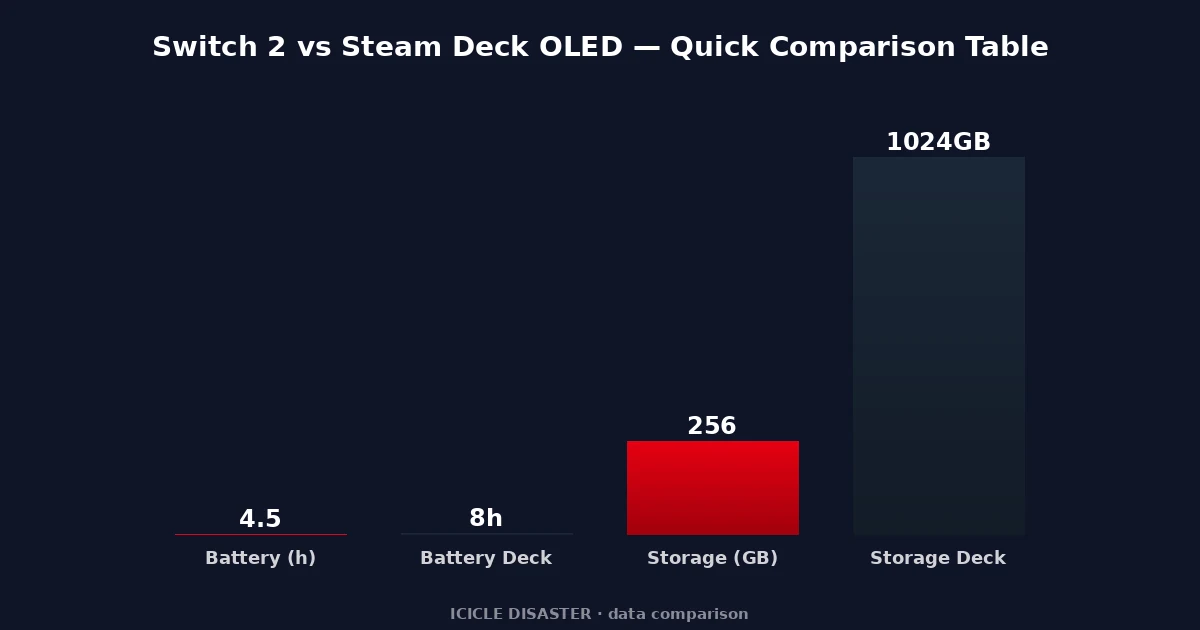
Quick numerical reference points before diving into ranked categories. The Switch 2 leads on first-party exclusives and battery-per-watt efficiency; the Steam Deck OLED leads on raw storage, library breadth, and modding flexibility.
#10 — Display Quality + OLED Comparison for HD-2D JRPG Visuals
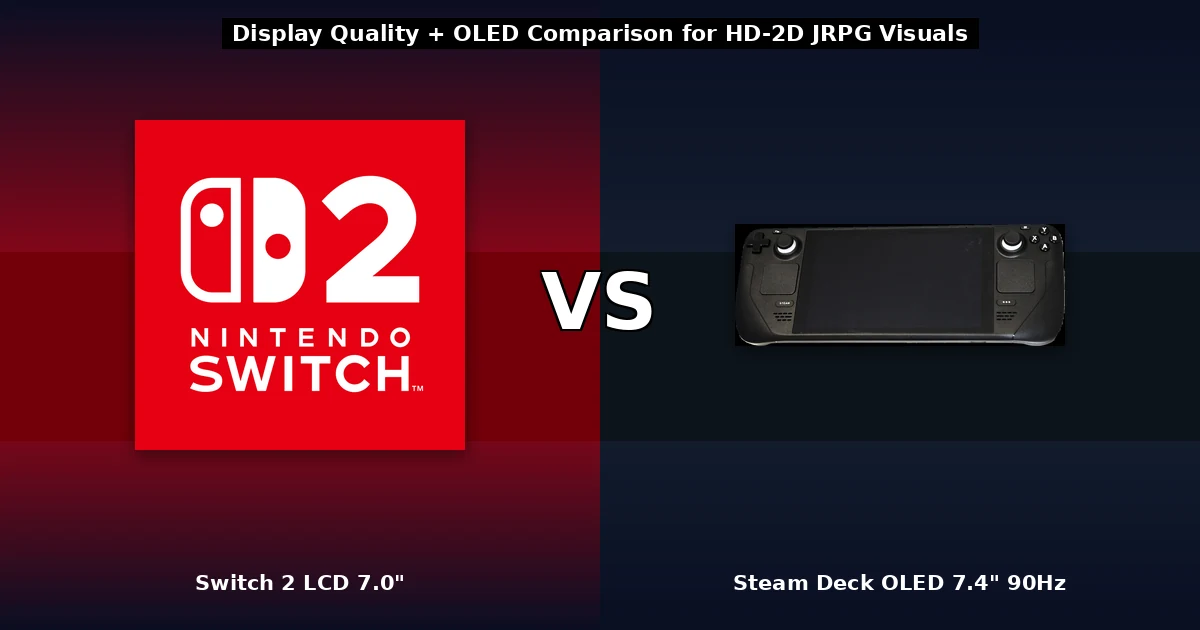
The Steam Deck OLED's HDR-capable panel renders HD-2D titles like Octopath Traveler II with deeper blacks and richer color saturation than the Switch 2's LCD. For JRPGs that lean on dark dungeon environments and stylized lighting (Persona's late-night chase sequences, Triangle Strategy's atmospheric battles), OLED is the clear winner. Switch 2 closes the gap with 120Hz refresh on some titles, but the panel ceiling holds it back from matching OLED contrast.
#9 — Battery Life for JRPG Marathon Sessions
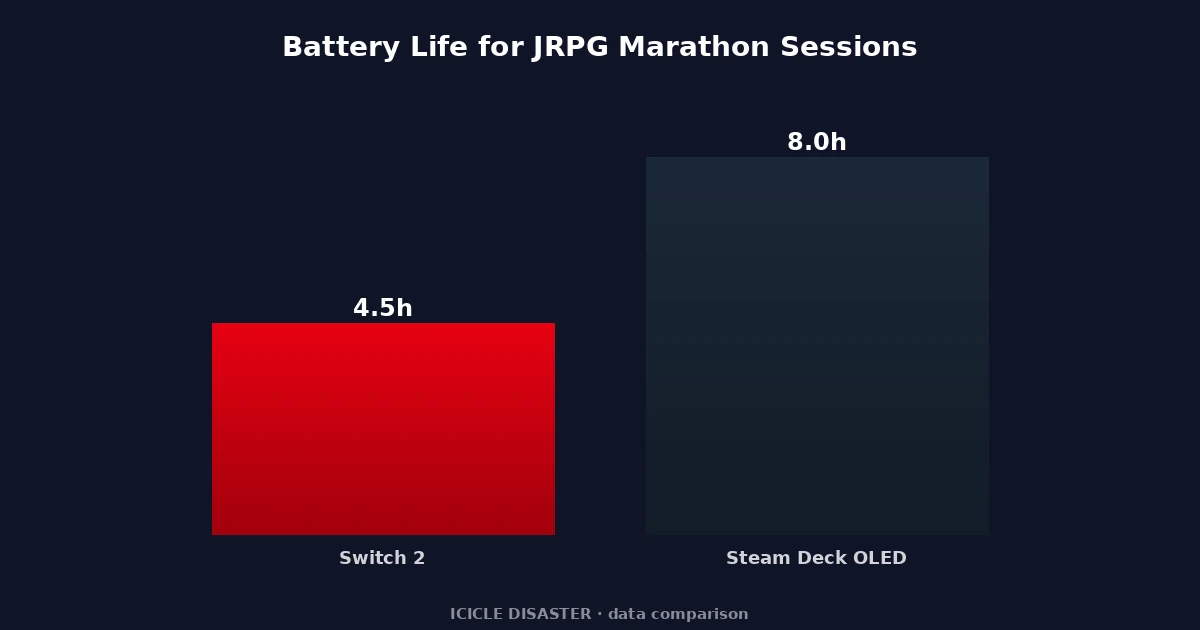
The Steam Deck OLED's 50Whr battery with the more efficient OLED panel delivers nearly double the JRPG playtime per charge versus the Switch 2's 4.5-hour window. For Persona-style 60-100 hour campaigns, this gap matters — Steam Deck players can complete an Atlus social link arc on a single battery cycle. Switch 2 players will hit the charger mid-session.
#8 — Storage + Save Backup Architecture for Long-Form Campaigns
Steam Deck OLED ships with 1TB NVMe SSD configurations versus Switch 2's 256GB UFS storage. For JRPG players accumulating 50+ hour campaigns across multiple titles, SSD architecture means no swap shuffle. Steam Cloud syncs saves automatically; Nintendo Switch Online cloud saves are eShop-only and rely on subscription continuity.
#7 — Native Game Optimization: Bespoke Ports vs Proton
Switch 2 ports are bespoke — Square Enix, Atlus, and Falcom optimize specifically for the device. Steam Deck relies on Proton (Valve's Wine-based Windows compatibility layer) for the vast majority of titles. Bespoke ports win on power-efficiency-per-frame; Proton wins on library breadth. For JRPG players running Falcom Trails entries year-over-year, Proton's 99% Tier-1-platinum verified rate makes the breadth advantage decisive.
#6 — Performance: DLSS vs FSR Upscaling for JRPG Rendering
Switch 2's NVIDIA Tensor Core support enables DLSS for first-party titles, hitting 4K-equivalent rendering at 60fps on supported games. Steam Deck OLED relies on FSR 3.1 — competent but visually noisier in JRPG menu text and HUD elements. For pixel-art and HD-2D titles where text sharpness matters more than raw resolution, the gap narrows. For 3D JRPGs with complex post-processing (Xenoblade Chronicles X, Final Fantasy XVI port), DLSS pulls ahead.
#5 — Game Library Access: eShop vs Steam + Epic + GOG

Switch 2 eShop catalog includes first-party Nintendo exclusives unavailable on PC — Pokemon, Fire Emblem mainline, Xenoblade exclusives. Steam Deck accesses Steam (with Steam Workshop), Epic Games Store (with free monthly titles), GOG (DRM-free), itch.io (indie scene). For breadth of JRPG inventory across pricing tiers and sale events, the PC ecosystem wins. For first-party Nintendo IP, Switch 2 is the only legal route.
#4 — Cloud Gaming: NSO Expansion vs Xbox Game Pass Ultimate
Nintendo Switch Online Expansion adds N64 + GBA + Sega Genesis libraries with cloud saves and online play. Xbox Game Pass Ultimate streams 400+ titles including newer Square Enix RPGs (FFXIV, FF14 mainline) directly to Steam Deck via Edge browser. For retro-leaning JRPG players, NSO Expansion offers a tighter curated catalog. For breadth + modern JRPG streaming, Game Pass wins.
#3 — Modding + Community Tools for FFXIV + Persona
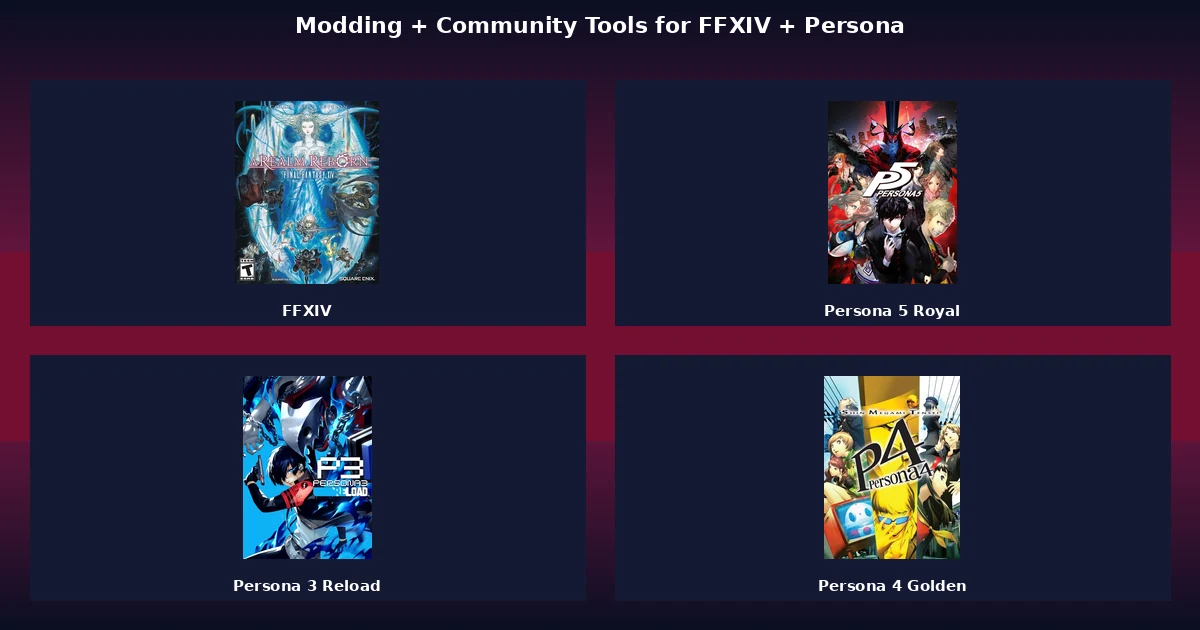
Steam Deck supports community modding for FFXIV (XIVLauncher), Persona 5 Royal (Reloaded II framework), and Atelier series (texture replacers, save editors). Switch 2 has zero modding support — Nintendo's hardware DRM and eShop signing prevent runtime modification. For Persona players who want UI mods or alternate dialogue translations, only the Steam Deck path works.
#2 — Emulation + Retro JRPG Backlog Access (NES → PS3)
Steam Deck runs RetroArch, Dolphin, RPCS3, PCSX2 — the entire emulation stack including legally-questionable PS3 JRPGs (Trails of Cold Steel originals, Tales of Vesperia PS3 exclusive). Switch 2's NSO retro library covers N64 + GBA + Sega but excludes PS-era JRPGs entirely. For backlog completionists chasing Final Fantasy XII PS2 or Suikoden II PS1 originals, Steam Deck is the only handheld route.
#1 — First-Party JRPG Exclusives (Fire Emblem / Xenoblade / Pokemon)
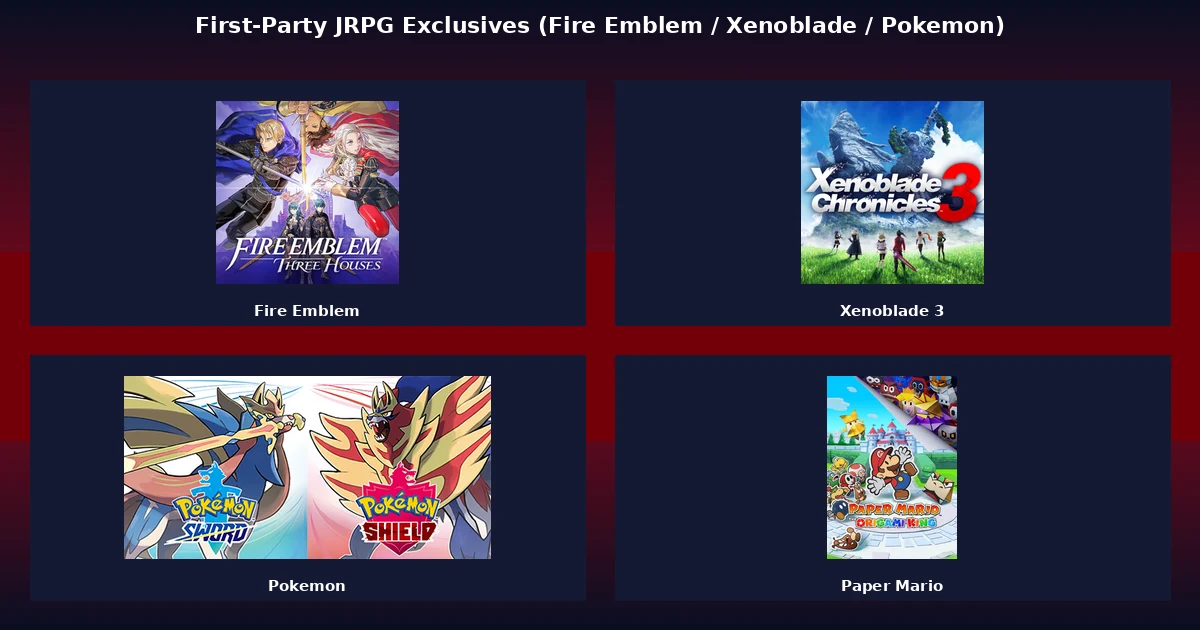
This is where Switch 2 wins decisively. Fire Emblem mainline, Xenoblade Chronicles series, Pokemon mainline, Paper Mario, and the next Mario RPG release — all Nintendo IP, all exclusive, all unavailable on PC legally. For JRPG players whose core taste centers on these franchises, the Switch 2 is mandatory. For everyone else, the Steam Deck OLED's nine other category wins matter more.
Switch 2 vs Steam Deck OLED: 2026 Verdict by JRPG Player Type

If you play primarily Nintendo first-party JRPGs (Fire Emblem, Xenoblade, Pokemon, Paper Mario) — buy Switch 2. If you play primarily third-party JRPGs (Persona, Final Fantasy, Trails, Atelier, Yakuza/RGG) — buy Steam Deck OLED. If you split, buy whichever covers your most-played franchise.
For modders and retro purists, the Steam Deck is mandatory regardless of franchise preference — the modding scene and emulation flexibility have no analog on Switch 2. For cloud-streaming-leaning players, both work, but Xbox Game Pass on Steam Deck offers more modern JRPG breadth than NSO Expansion.
Official specs from Nintendo and Valve Steam Deck page provide authoritative reference for hardware claims. Our editorial verdict synthesizes 2026 release calendar realities plus the JRPG-niche use cases each device serves uniquely.