I recall a medieval toy set I had as a child — plastic knights, kings, thieves, and villains. With imagination, I added sorcerers and witches, spun tales of warring nations and dark forces. Shining Force resparks that whimsy. It's a storybook the player inserts himself into, a Dark Ages fantasy of sprites and tiles where a modest band grows into a small army. The story is pure fairy tale: evil forces awaken, a hero rises, allies join one by one. What makes it work isn't originality but earnestness — Shining Force believes in its own simplicity, and that sincerity is infectious.
The Grid: Simple Tactics with Character Attachment
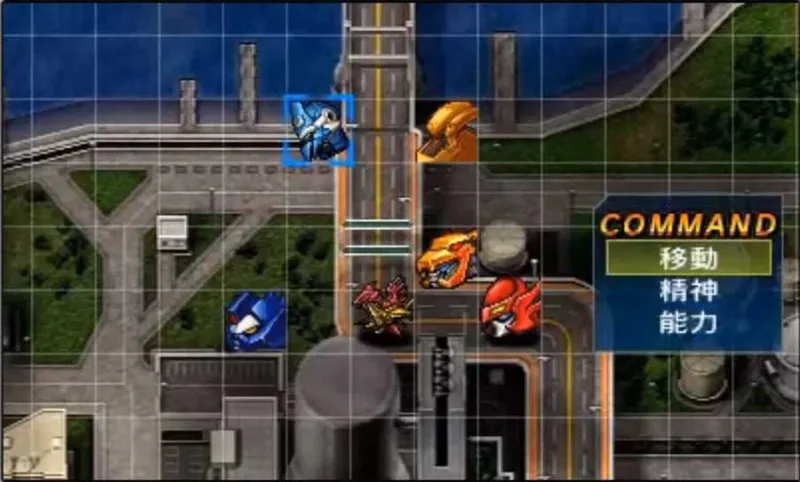
Battles are grid-based with simple rules: move, attack, cast. No elevation, no facing direction, no complex terrain modifiers. What Shining Force offers instead is character variety — twelve deployable units from a roster that grows to thirty, each with distinct sprites and roles. A centaur knight, a flying hawkman, a steam robot, a werewolf. You care about these units because they look different, move different, and die permanently if you're not careful. The tactics are basic compared to Fire Emblem or Tactics Ogre, but the roster management — choosing who to deploy, who to bench, who to promote — creates genuine attachment.
The Enemy Turn: Where Patience Dies
And then there's the enemy turn. In Shining Force, every enemy unit moves individually, with a pause between each. Ten goblins who passed their turns suddenly felt like a mockery of the time I was wasting. Evil creatures, the whole lot of them. The enemy phase on large maps — twenty, thirty units all taking individual actions — is genuinely painful. There's no speed-up toggle, no skip button, no mercy. You watch goblins shuffle one tile to the left, one at a time, while the Genesis sound chip plays the same four notes. It's the game's biggest flaw and the reason replays require a specific kind of patience that I'm not sure I still possess.
The Roster: Thirty Characters, Twelve Slots
Shining Force gives you thirty recruitable characters and lets you deploy twelve per battle. That's eighteen benched units watching from the sidelines while you agonize over the starting lineup. A centaur knight with the highest movement range. A steam robot whose attack power outscales everyone else by mid-game but joins underleveled. A flying hawkman who ignores terrain but has paper-thin defense. A werewolf who transforms at low health — do you deliberately let him take damage for the power boost, or is that too risky? The roster management creates genuine attachment because every deployment slot is contested. Choosing Zylo the werewolf means benching Diane the archer, and that trade-off feels personal rather than statistical. The characters don't have support conversations or backstories beyond their recruitment scene, but their visual distinctiveness — a samurai, a monk, a dragon child, an armadillo knight — gives them personality that numbers alone don't provide.
The Promotion System: When Class Changes Actually Matter

At level 10, units can promote to advanced classes — Knights become Paladins, Mages become Wizards, Warriors become Gladiators. The catch: promotion resets your level to 1, temporarily weakening the unit before they scale past their pre-promotion peak. Do you promote at level 10 for faster access to advanced skills, or grind to level 20 for maximum pre-promotion stats? The meta-game answer is "promote at 20," but in practice, the patience required to grind a unit from 10 to 20 on the Genesis's slow battle system tests even the most dedicated min-maxers. I promoted most units at 12-14 because I wanted the advanced class sprites — the visual upgrade from Knight to Paladin, from Warrior to Gladiator, is satisfying enough to justify suboptimal stat growth. Sometimes RPG decisions are about what looks cool, not what's mathematically correct.
The Age Question: Can You Play This in 2026?
Shining Force is a 1992 Genesis game, and it plays like one. The text scrolls slowly. The menus are clunky. The enemy AI is either brain-dead (walking past your frontline to attack a healer) or frustratingly random (ignoring your tank to one-shot your mage). The battle animations are charming in their simplicity — two sprites colliding, a damage number, done — but they can't be skipped, and watching thirty enemy units take their turns one by one in late-game battles is genuinely painful. An emulator with speed-up functionality transforms the experience: 2x speed makes enemy turns bearable, and save states remove the frustration of losing a promoted unit to a random critical hit. Without these tools, Shining Force requires a tolerance for retro pacing that most modern players don't have. With them, it's a tactical RPG with a roster system and fairy-tale charm that the genre has largely abandoned in favor of complexity.
The Verdict: A Storybook Worth Opening Once
Shining Force is a game I recommend with the caveat that it's a product of 1992 and proud of it. The tactical combat is simple but charming. The roster variety creates genuine attachment. The storybook presentation — town exploration between battles, NPC conversations, hidden characters — gives the game a warmth that more complex tactical RPGs sometimes lack. But the enemy turns are brutal, the difficulty is uneven, and the game has aged in ways that emulator speed-up buttons were invented to address. Play it on Genesis, via the Sega Genesis Classics collection, or on mobile. Bring patience. The goblins will test it.
Shining Force spawned a franchise — Shining Force II improved on every front with larger battles, better pacing, and a world map that felt connected rather than linear. Shining Force III (Saturn) added three-scenario storytelling that was decades ahead of its time. But the original remains the entry point: simple, charming, and honest about what it is. A storybook with swords, a chess game with personality, and an enemy phase that tests your tolerance for goblin logistics. The Genesis classic is available through Sega Genesis Classics on modern platforms, or through the Mega Drive Mini. Bring an emulator speed-up button. The goblins demand it.
For players who want tactical RPGs with more depth, Tactics Ogre and Fire Emblem offer significantly more complex systems. But neither has a steam robot or a werewolf in the starting roster, and sometimes that's what matters more than tactical perfection.
All images are official screenshots from their respective publishers. Updated March 31, 2026.