Konami's Suikoden I & II HD Remaster finally landed on modern hardware in 2024 after nearly two decades of being trapped on PSone discs and dubious emulation. The question every JRPG fan immediately asked: did Konami actually do justice to two of the genre's most beloved entries, or is this another half-effort cash-in on franchise nostalgia? Icicle Disaster has reviewed and ranked over 250 JRPGs since 2017 (see our comprehensive JRPG rankings) — including Suikoden II's longstanding presence as one of the must-play short JRPGs under 15 hours — so the verdict here comes from direct playtime with both the originals and this remaster, not from press preview footage.
The short answer: yes, mostly. The remaster preserves the things that made Suikoden I and II legendary (the 108 Stars of Destiny recruitment system, the political-tragedy narrative weight, the spritework) while modernizing the rough edges (loading times, save flexibility, language options). It's not the ground-up reimagining some fans wanted, but for a faithful HD remaster of two 25-year-old games? It's exactly what the franchise needed.
Suikoden I — The Original 108 Stars Begins Here
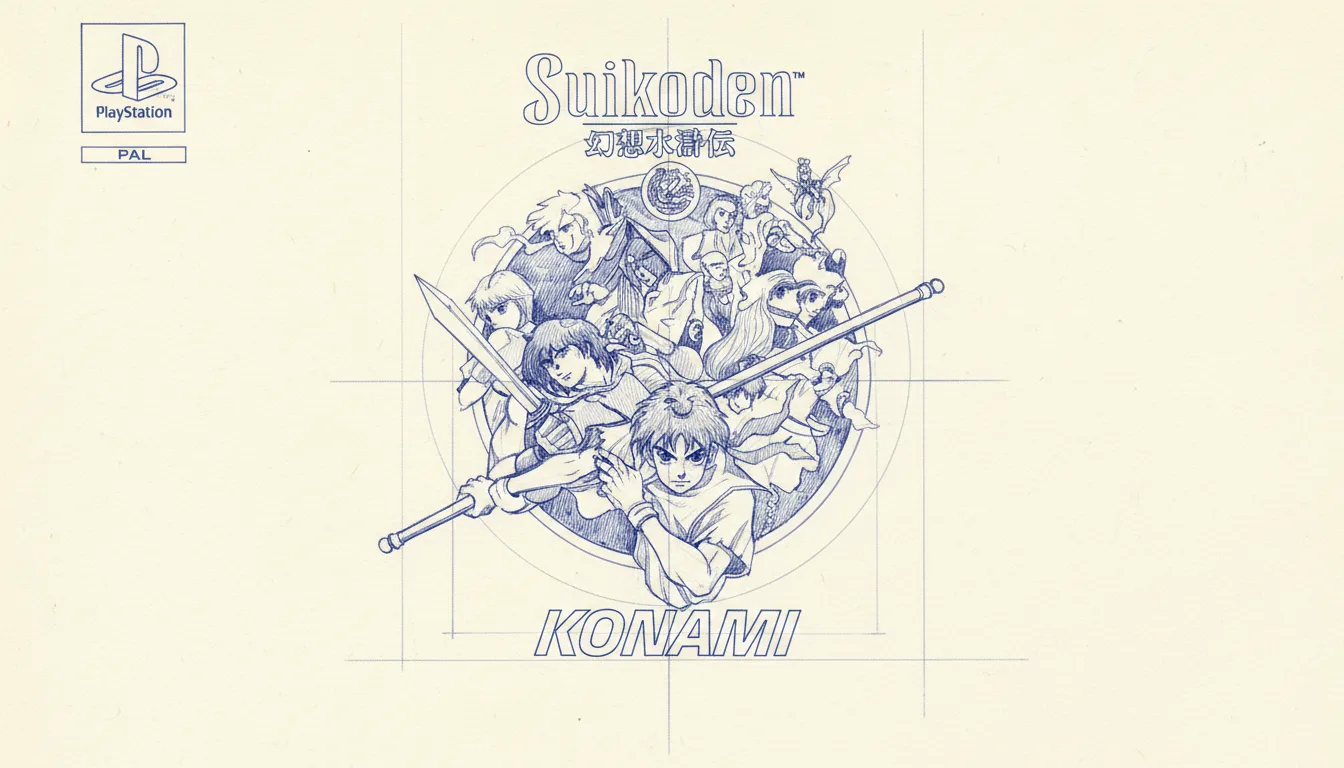
Suikoden I (1995 PSone original, now HD Remastered) tells the story of Tir McDohl — a young noble whose father serves as a Great General of the Scarlet Moon Empire. When the Empire's corruption becomes too obvious to ignore, Tir defects, recruits 107 other "Stars of Destiny" across the continent, and leads a rebellion that reshapes the political map. That 108-character recruitment loop is the franchise's signature mechanic, and it remains genuinely radical even by 2026 JRPG standards. No other franchise has matched the scale of party composition Suikoden built in 1995.
Combat is classic turn-based with a six-character active party, but the depth comes from the rune system (each character can equip Rune crystals that grant magic spells with limited charges per encounter) and the unite attacks (specific character pairings trigger multi-character combo attacks with their own scripted animation). For a 16-bit-era system designed in 1995, this hit harder mechanically than Final Fantasy VII would two years later. The HD Remaster's quality-of-life additions — auto-save, fast-forward during random encounters, and dual-language audio (Japanese voiceover finally available outside Japan) — make the 15-20 hour campaign a brisk, modern-feeling experience without diluting any of the original design (compare to the 100+ hour commitments documented in our 100-hour completionist roundup for context on Suikoden's compact runtime).
Story-wise, Suikoden I is the franchise's most political entry. The Scarlet Moon Empire's collapse isn't framed as good-vs-evil — it's framed as the inevitable corruption that comes when systems persist beyond their justification. Tir's father, Teo McDohl, is a sympathetic antagonist whose loyalty to the Empire is the most painful element of the entire campaign. By the time the credits roll, the political weight of the Stars of Destiny gathered around Tir feels earned rather than mechanical. The HD Remaster's preserved pixel-art portraits remain some of the most memorable in JRPG history. Suikoden I is the foundation that made Suikoden II's masterpiece status possible.
Suikoden II HD Remaster Review — One of the Genre's Greatest
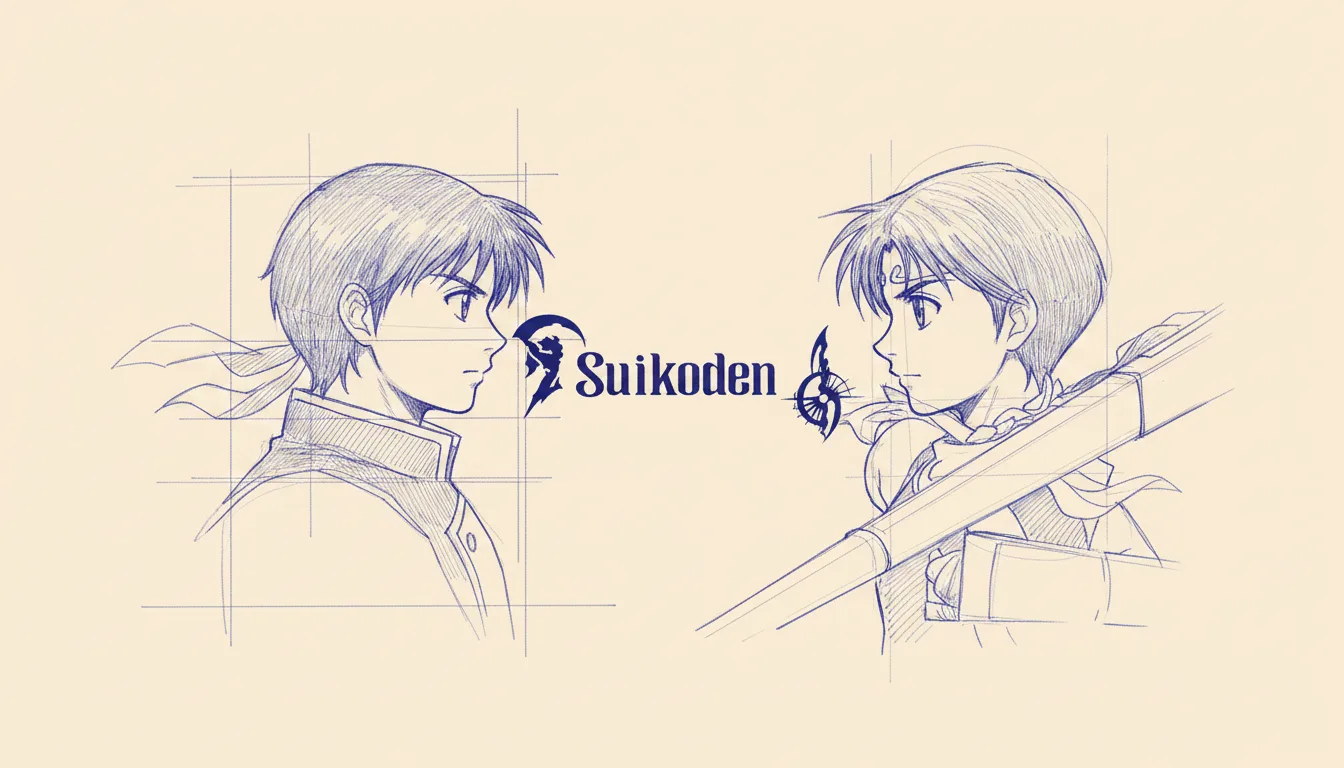
Suikoden II (1998 PSone, now HD Remastered) is the entry that converted skeptics into Suikoden lifers. Where Suikoden I established the 108 Stars system, Suikoden II perfected it. The story follows Riou (the silent protagonist) and Jowy Atreides — two childhood friends serving in the same Highland youth brigade who, through circumstances neither chose, end up leading opposing nations in a war that will define the rest of their lives. The Riou-Jowy friendship-betrayal arc is, without exaggeration, one of the most emotionally complete narratives the entire JRPG genre has ever produced. It belongs in the same conversation as Final Fantasy VI's Kefka arc and Chrono Trigger's Lavos finale (see our Final Fantasy series ranking for the era-comparison context).
Mechanically, Suikoden II expands every system Suikoden I introduced. The Recruitment now spans Highland Kingdom, City-State of Jowston, and dozens of side regions — each with multi-stage recruitment quests featuring named NPCs with their own arcs. The Strategic War Battles (real-time army combat scaled across continent-spanning campaigns) give the war a tactical weight that pure turn-based JRPGs of the era couldn't match. The Castle system lets you customize your headquarters with recruited Stars, and seeing your gathered army grow from a handful of rebels to a continent-defining force creates a unique JRPG progression loop. The HD Remaster preserves all of this while adding the same QoL layer as Suikoden I (auto-save, fast-forward, dual-audio).
The narrative payoffs in Suikoden II are what elevate it beyond "great JRPG" into "all-time JRPG masterpiece" territory. Without spoiling specifics: the Riou-Jowy arc resolves three times across the campaign (childhood, mid-game, finale), and each resolution lands harder than the last. The 108 Stars system creates emotional stakes around even minor recruited characters — when one of them is in danger during the war, the Recruitment becomes more than mechanics. It becomes personal. Suikoden II remains, alongside Final Fantasy VI and Chrono Trigger, the JRPG that 1990s critics correctly identified as defining the genre's narrative ceiling. The HD Remaster makes it accessible to players who weren't gaming in 1998 — and for those of us who were, it makes the original playable on modern hardware without emulation friction.
What the HD Remaster Actually Adds (and What It Wisely Leaves Alone)
The HD Remaster's modernization focuses on quality-of-life additions that don't disrupt the original design. Auto-save eliminates the PS1-era anxiety of losing 30 minutes of progress to a random crash. Fast-forward during random encounters keeps grinding sessions from becoming punishing. Dual-language audio (Japanese voiceover added for the first time globally) provides authenticity option that the 1995/1998 originals never offered outside Japan.
What Konami wisely didn't change: the pixel-art aesthetic, the rune-system depth, the recruitment loop. The original sprite work is upscaled cleanly but not "redrawn" or "modernized" in a way that would erase the artistic identity. The HD Remaster understands that for a remaster (not a remake) the goal is to make the original playable on modern hardware, not to second-guess design decisions that defined the franchise's identity.
Platform availability matters here. The remaster shipped on PS4, PS5, Nintendo Switch, Xbox Series, and PC simultaneously — cross-platform parity that makes Suikoden accessible to any modern player regardless of preferred hardware. The Switch version in particular fits the franchise's appeal: portable JRPG sessions with the Recruitment loop are perfect commute play (see our best JRPGs on Nintendo Switch for context on the platform's JRPG library depth).
Why Suikoden I and II Belong in Classic JRPG Canon
Suikoden I and II are routinely listed alongside Final Fantasy VI and Chrono Trigger as the defining 16-bit-era JRPG narrative achievements — and that's not nostalgia talking. The 108 Stars of Destiny system created a JRPG mechanic no other franchise has successfully imitated. The political-war framing introduced a tonal seriousness that the more fantasy-romance-oriented FF and Dragon Quest entries of the era avoided. The Recruitment loop is functionally a 1995 implementation of what modern open-world JRPGs (see our best open-world JRPGs ranking) attempt with sidequest-driven character acquisition systems.
For players approaching JRPGs from the modern era who want to understand why the genre's classic entries still matter (see what JRPG actually means for the broader genre definition), Suikoden I+II are essential reading. They're shorter than the modern 80+ hour Final Fantasy or Persona campaigns (Suikoden I = 15-20h, Suikoden II = 30-40h completionist) — see our best JRPGs under 30 hours roundup for adjacent compact picks — but the narrative density per hour rivals anything released since.
The Verdict — Is the HD Remaster Worth Buying in 2026?
Yes — unequivocally yes, for any JRPG fan who hasn't played both games. The HD Remaster is the definitive accessible way to experience two of the genre's foundational classics in 2026. Konami delivered a faithful preservation with modern quality-of-life additions, cross-platform availability, and dual-language audio that the original releases never offered globally.
The only audience for whom this might not be essential: players who already played both games to completion on PSone and don't want to revisit. Even then, the dual-language audio + Switch portability are compelling enough to justify a replay. For everyone else — players who missed Suikoden in the 1990s, players who tried emulation and bounced off the UI friction, or players who've heard Suikoden II referenced as "best JRPG ever" and wondered if the hype was earned — the HD Remaster is the right starting point.
Rating: 9.0/10. Suikoden II is one of the best JRPGs ever made; Suikoden I is the foundation that made it possible. The HD Remaster delivers both with the modern QoL layer needed to make them accessible without diluting any of the original design. Konami's most fan-pleasing remaster effort to date. Buy it.
Frequently Asked Questions
Is the Suikoden I & II HD Remaster worth buying in 2026?
Yes — unequivocally for any JRPG fan who hasn't played both games. Konami delivered a faithful HD preservation of two genre-defining classics with modern quality-of-life additions (auto-save, fast-forward random encounters, dual-language Japanese audio added globally for first time). Cross-platform availability (PS4/PS5/Switch/Xbox Series/PC) eliminates hardware barriers. Suikoden II remains one of the genre's all-time-best JRPGs alongside Final Fantasy VI and Chrono Trigger; Suikoden I is the foundation that made Suikoden II possible. Rating: 9.0/10. Buy it.
Which Suikoden game is better — I or II?
Suikoden II is the consensus pick as one of the best JRPGs ever made. The Riou-Jowy friendship-betrayal arc is the franchise's emotional peak, with three escalating resolutions across the campaign. Suikoden II also expands every system Suikoden I introduced — the 108 Stars Recruitment is deeper, the Castle headquarters customization is richer, the Strategic War Battles add tactical scale. Suikoden I (15-20h compact) is still excellent and provides essential context for Suikoden II's references, but if forced to play only one: Suikoden II (30-40h completionist). Play both via the HD Remaster bundle for the full experience.
What's the 108 Stars of Destiny system?
The 108 Stars of Destiny is Suikoden's signature mechanic: each game challenges you to recruit 108 named characters (each based on a Star from Chinese folklore Water Margin) across the world. Each recruited Star has named NPC arcs, recruitment quests with named requirements, and combat/Castle utility (some are party-eligible warriors, others are merchants, inventors, blacksmiths, etc.). The 108 Stars roster transforms your rebel headquarters into a full military operation. No other JRPG franchise has matched this scale of party-and-base building in 30 years. Achieving all 108 unlocks the canonical 'good' ending in both games.
How long does Suikoden I & II HD Remaster take to beat?
Suikoden I main story: 15-20 hours focused run, 20-25 hours with most 108 Stars recruited. Suikoden II main story: 25-30 hours focused, 35-40 hours completionist with 108 Stars + true ending requirements. Combined I + II = 50-65 hours total for completionist run across both games. The HD Remaster's fast-forward during random encounters reduces grinding friction significantly vs the original PS1 releases. Suikoden I is one of the most compact great JRPGs ever made — see our best JRPGs under 30 hours roundup for adjacent compact-runtime picks.
Is Suikoden II really one of the greatest JRPGs ever made?
Yes — Suikoden II is consensus-listed alongside Final Fantasy VI, Chrono Trigger, and Persona 4 Golden in 'best JRPGs ever' discussions. The Riou-Jowy friendship-betrayal tragedy is the franchise's defining narrative achievement, with emotional payoffs that land harder than most modern 80+ hour JRPG runs. The 108 Stars Recruitment creates stakes around even minor characters in a way the JRPG genre never replicated. The political-war framing (Highland Kingdom vs City-State of Jowston) introduced a tonal seriousness that 1990s JRPGs (then dominated by lighter fantasy-romance entries) generally avoided. 25+ years post-release, Suikoden II's reputation only grew. The HD Remaster makes this masterpiece finally accessible without PS1-era friction.
What platforms is Suikoden I & II HD Remaster available on?
Cross-platform 2024 launch: PlayStation 4, PlayStation 5, Nintendo Switch, Xbox Series X|S, and PC (Steam). No hardware barrier for any modern player. Switch portable mode is particularly well-suited to the franchise — the Recruitment loop + turn-based combat work perfectly for commute play sessions. PS5 + Xbox Series versions deliver native 4K/60fps with full DualSense haptic feedback support. PC version supports modding and full graphics customization. Konami's cross-platform parity is the most competent of their recent remaster efforts.