
A bored NPC sits near the starting bonfire. He gives you an objective — not a mission, just a passing mention: "Ring the bell atop the chapel, and maybe something happens." The man doesn't expect you to succeed. He doesn't seem to care. It's an entirely dull affair, like he's seen a million of you before. "Ring the bell, why don't you?" Well alright. Maybe I will. I played Dark Souls on PS3 in 2011, died to the Taurus Demon nine times, quit for three months, came back, and finished it in a fever state that lasted two weeks. Then I played the Remastered version in 2020 and discovered that Lordran is simultaneously one of the best-designed worlds in gaming and one of the most inconsistent games I've ever finished. Both things are true. Neither cancels the other.
Lordran: The Greatest Level Design in Gaming (First Half)
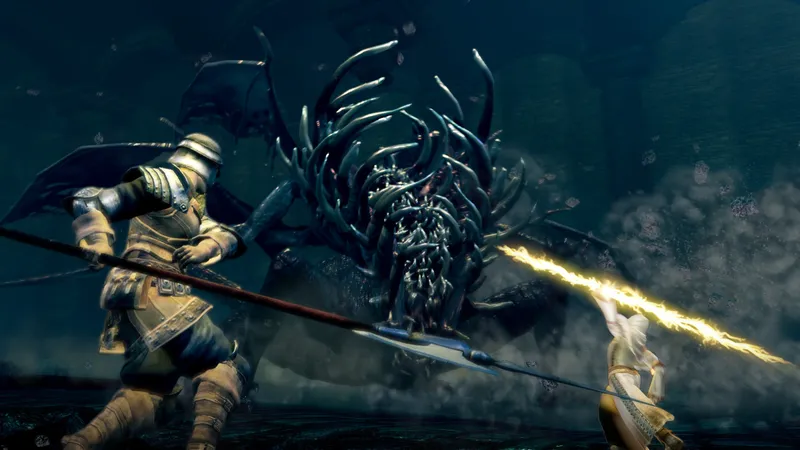
Where the world turned awry, how it persists, and why it continues in its decrepit state — those are the questions Dark Souls poses through architecture rather than exposition. An introductory cinematic gives a biblical overview: an age of dragons, fire introduced to the world bringing light and dark, and now the flame is fading. Lordran contains the remnants — dragons, witches, devolved kings, grotesque gravelords, minotaurs, tortured demons — all waiting in some chamber, cave, or crevice for the day a player persists long enough to find them.
The level design in the first half is the reason Dark Souls became a cultural phenomenon. From the starting bonfire at Firelink Shrine, paths branch upward through stone fortifications manned by hollow soldiers, outward into forests of animated trees and bronze giants, downward into catacombs of necromancers and abandoned mines. Every path eventually connects back to where you started through raised gates, kicked ladders, and elevator levers that create shortcuts you didn't know existed. The feeling when you open a gate and realize you've circled back to Firelink Shrine from the opposite direction — that's the "childlike discovery" that people mean when they talk about Dark Souls. "What the hell is down here?" becomes the game's real objective, and the answer is always something that can kill you, which makes finding it feel like forbidden knowledge.
The Combat: Psychological Turn-Taking in Medieval Armor
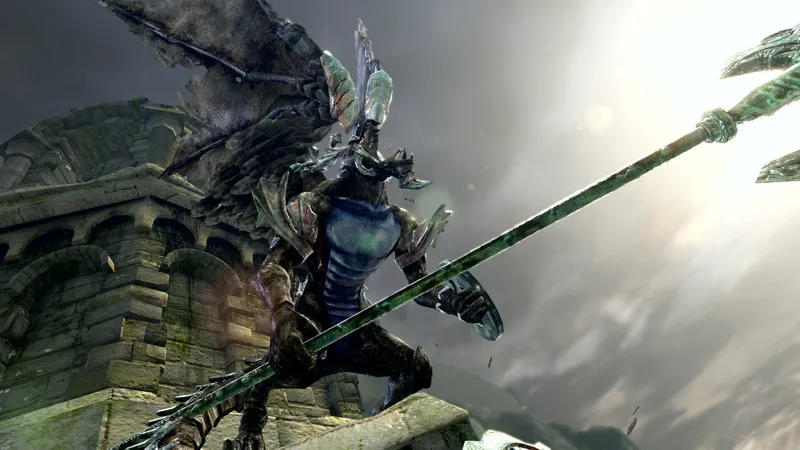
Dark Souls is an action RPG played in clanky medieval armor, a shield in the left hand, and a dodge roll mapped to circle. It's less reflexive than psychological — a form of turn-taking where one side waits to see the other's animation and reacts. The undead spear warrior's lunge impales you the first time and does lethal damage. You respawn at the bonfire. All previously cleared enemies have returned. The mental gymnastics begin: frustration first, excuses next, then a plan. "I just needed to backpedal there." Fight your way back, climb the steps, defeat the bomb tossers, and here comes the spear lunge — except it has a follow-up. Two fiercer attacks in quick succession. Back to the bonfire.
The gears spin again: "This game does not deserve my attention." But then you're back up those fortifications, waiting for the spear strikes to finish, demolishing the soldier with whatever weapon you've committed to, collecting his souls, moving forward a bit further. Call it tedious, because it is. Stripped of everything else, Dark Souls would be nothing more than tedium. The itch to try again comes from the world around the combat — the scope that keeps growing, the secrets behind every fog door, the lure of finding out what's next. The combat serves the exploration. Not the other way around.
How Hard Is It, Actually?
Less than its reputation suggests. Mechanically, Dark Souls is quite slow. The dodge roll has generous invincibility frames. You carry ten health flasks that restock at every bonfire. The game has an obligation to be playable, and for all its punishing reputation, it meets that obligation — provided you play a basic build. Shield and melee weapon. Invest in Vitality and Endurance. Don't try to be clever with magic on your first run.
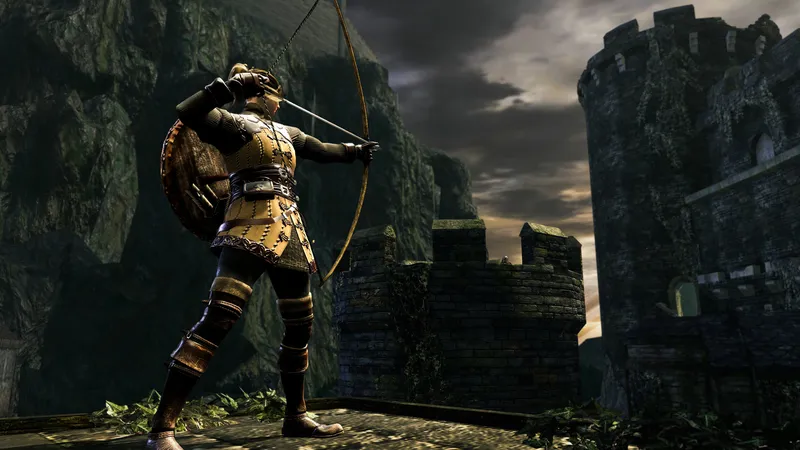
The real difficulty is patience. Tolerating tedium. A pitch-black shanty town of ladders and poisonous muck where you might hop to a rooftop that looked like a ledge, except it's the edge of the map and you fall to your death. Archers on opposite ends of narrow walkways — the Anor Londo archers specifically, who have become a community punchline because they're genuinely unfair. Unavoidable swamps that poison and drain your health while you wade through them at walking speed. Treasure chests that might just — well, you'll see. One enemy early on can curse you, halving your HP pool with no obvious cure. A new player might never discover the fix, and with half health as the baseline for every future encounter, they might quit forever. Dark Souls isn't for them. But it's regretful, because they were one dodge roll away from not being cursed and otherwise enjoying the game.
The infamous mid-game boss — two large men with overlapping character models, glitching weapons through stone columns, zooming around a room with janky dash pathing — is cheap as dirt. If you quit there, I couldn't blame you. The difficulty conversation around Souls games always ends in the same loop: "It's meant to be hard." "This specific part isn't hard, it's broken." "Get good." The loop is exhausting because both sides are right about different things.
Where Lordran Falls Apart
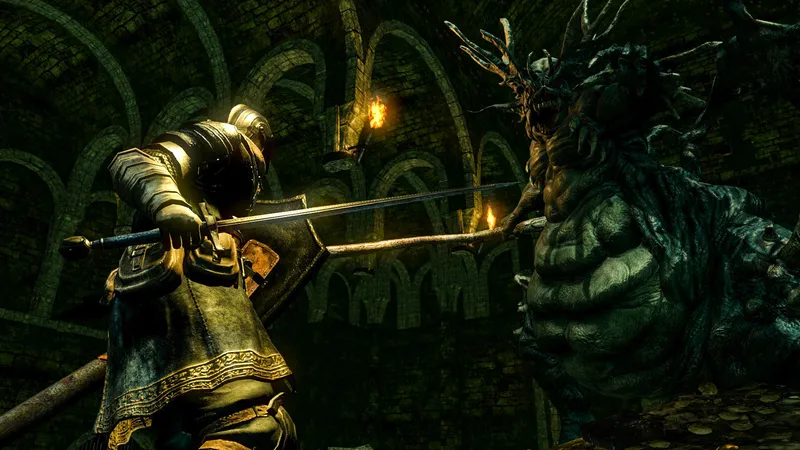
The first half of Dark Souls is a masterclass. The second half is not. After the mid-game pivot (you'll know it when you get the Lordvessel), the interconnected design that made early Lordran special is abandoned. Areas become linear corridors connected by warps rather than shortcuts. Some zones feel unfinished — and I don't mean "intentionally sparse." I mean unfinished. One area is littered with repeated enemy models standing shoulder to shoulder as if the designer spammed copy-paste and shipped it. Past there, creatures appear with half their anatomy missing. You cannot make this up. One forest area is dark, atmospheric, and beautifully rendered. Another looks like a green field with paper cutouts for trees.
The stat system deserves criticism too. New players get no clean explanation of what stats do, which ones are traps (Resistance), or which builds become unviable in the late game. Dark Souls punishes you for making the wrong character, and it punishes you retroactively — you won't discover your build is broken until twenty hours in, when the damage you deal stops scaling and every boss becomes a war of attrition the game didn't intend. "Do yourself a favor and stay basic" shouldn't be advice a reviewer has to give. The game should communicate it. It doesn't, because obtuseness is the aesthetic, and Dark Souls would rather lose a player than explain itself.
The Knight in the Forgotten Realm
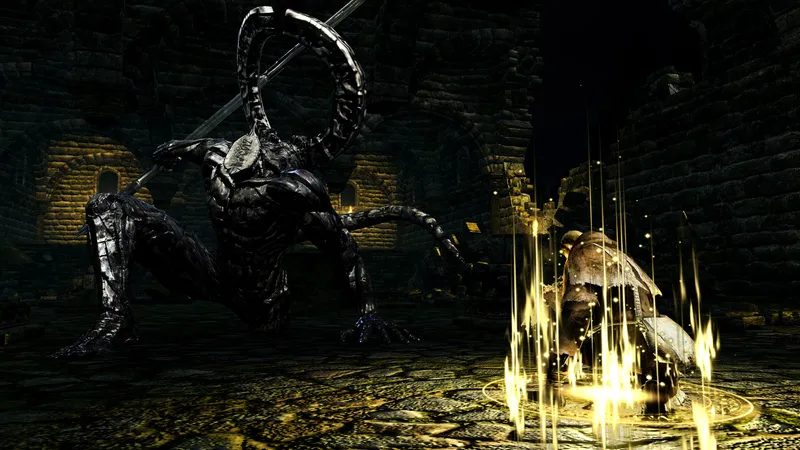
There is one area — a forgotten realm — that leaves the strongest imprint from Dark Souls. Here, a knight is seen. Head to toe in regal armor, gauntlets clasped atop the hilt of a greatsword. He's just standing there. As you cautiously approach, it seems he's always been standing there. No sign of humanity left in the world, and this man — or just a thing now, really — is at some designated post, staring through the slits of a helmet out toward a dead world. Forever he has been there, guarding something forgotten.
Then you get closer. And like clockwork, he picks up his blade and very smoothly strides over to kill you. That's Dark Souls. Not the difficulty. Not the "YOU DIED" screen. Not the discourse about whether it's fair or frustrating. It's the knight in the forgotten realm — something that was once human, still performing its duty in a world that's moved on, and the quiet horror of realizing that you might be doing the same thing. Ringing bells, killing bosses, linking fires, all because a bored NPC told you to and you didn't have anything better to do. The world is indifferent to sharing its secrets, and the secrets are haunted because the world doesn't care whether you find them or not.
The Verdict: A Broken Masterpiece (And I Mean Both Words)
Dark Souls is a game I'd score differently depending on which half you asked about. The first half — Undead Burg through Anor Londo — is among the best world design in gaming history. Interconnected, atmospheric, secrets layered behind lethal obstacles, shortcuts that make you gasp with recognition. The second half — Lost Izalith through the Kiln — is rushed, unfinished in places, and coasts on the goodwill the first half built. The combat is slow and deliberate in ways that reward patience, but the game occasionally mistakes unfairness for challenge and never acknowledges the difference.
Play it anyway. Play the Remastered version on Steam, PlayStation, or Switch. Stay basic on your first build. Keep a shield up. Don't look things up unless you're truly stuck — the discovery is the point, and every wiki page you read is a shortcut you'll never open for yourself. And when you meet the knight in the forgotten realm — standing there, staring at nothing, forever — sit with that image for a moment before you fight him. It's the most Dark Souls thing in Dark Souls, and no amount of "YOU DIED" screens will take it from you. That encounter alone is worth the frustration. Almost all of it.
All images are official screenshots from Dark Souls: Remastered (FromSoftware / Bandai Namco). Originally published February 2016. Updated March 30, 2026.