Both games sit near the top of the JRPG canon, and both get recommended constantly to anyone who asks where to start with the genre. I've completed Persona 5 Royal and Fire Emblem Three Houses in full — this site runs on that kind of direct play experience across 250+ ranked titles — so when I say one is the right call for you, I mean it. The problem is they're not the same kind of game at all. Putting them head-to-head without framing the comparison correctly just produces noise.
Here's how to actually decide.
The Short Answer: It Depends on One Question
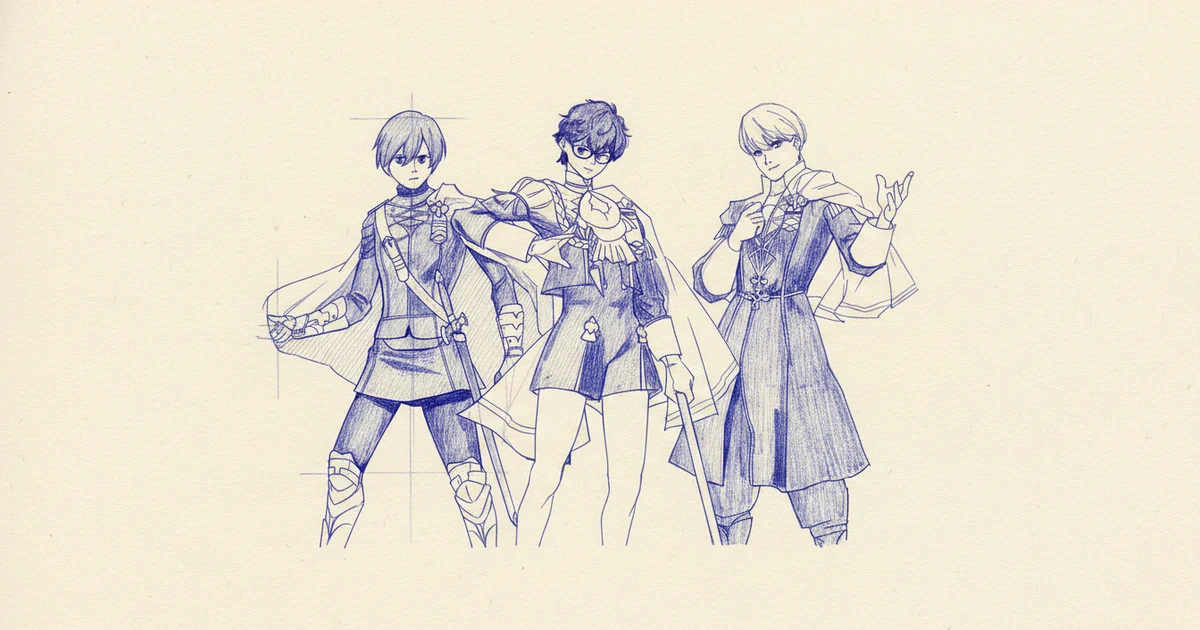
Do you want a character-driven urban RPG where you manage a social calendar, crawl supernatural dungeons, and watch a tight cast of misfits dismantle institutional corruption? Play Persona 5 Royal. Do you want a tactical strategy RPG where you build an army, maneuver units on a grid, and replay the same war from opposing ideological sides? Play Fire Emblem Three Houses.
That's the axis. Everything else — art style, music, runtime — is secondary to that fundamental split in how these games actually play.
Gameplay Loop: Turn-Based Dungeon Crawling vs. Tactical Grid Combat
Persona 5: Calendar, Palaces, and Social Stats
Persona 5 Royal runs on a strict in-game calendar. Every day you spend in Tokyo, you're choosing between advancing a dungeon (Palaces or the procedurally generated Mementos), leveling a Confidant relationship, studying for exams, or building social stats like Charm and Knowledge. Time is always the constraint. Combat inside Palaces is turn-based and built around elemental weaknesses — hit an enemy's weakness, knock them down, trigger an All-Out Attack with your party. It's snappy, stylish, and mechanically tight.
The life-sim layer isn't decoration. Confidant ranks unlock combat abilities and Persona fusion bonuses, so who you spend time with has direct mechanical consequences. You're always optimizing across two games at once: the dungeon crawler and the social sim.
Fire Emblem Three Houses: The Monastery, Battalions, and Permadeath
Three Houses wraps its tactical combat in a similar structure — between battles, you manage Garreg Mach Monastery, instruct your students, build weapon skills, and run side missions. But the preparation points toward a fundamentally different payoff: positioning and unit survival on a tactical grid.
Combat is turn-based strategy, not dungeon crawling. You move units across a map, manage battalion gambits, exploit enemy weaknesses with the right weapon types, and try not to lose anyone. In Classic Mode, a unit that dies stays dead for the rest of the run — permadeath is a real consequence that forces careful play. Three Houses also offers Casual Mode, which removes permadeath entirely, making it a reasonable entry point for players who want the strategic depth without the punishing stakes. That's a meaningful accessibility choice worth knowing before you commit.
Both games reward preparation before the main action. But Persona 5's prep feeds a dungeon crawler, and Three Houses' prep feeds a tactics game. If you already know which of those appeals to you more, the decision is basically made.
Story and Characters: High School Rebellion vs. Continent-Scale War
Persona 5 Royal tells a single story from start to finish. Joker and the Phantom Thieves move through a structured sequence of targets — corrupt adults holding power over vulnerable people — and the game builds steadily toward a confrontation with the systems enabling that corruption. The cast is tight, the pacing is controlled, and Royal added Kasumi Yoshizawa as a new Confidant alongside a third-semester story extension that deepens the thematic payoff. You play it once and get a complete, cohesive experience.
Three Houses works completely differently. The game has four distinct routes — Black Eagles, Blue Lions, Golden Deer, and the alternate Crimson Flower path within the Black Eagles — each telling the same continent-wide war from a different faction's perspective, with different battles, different character deaths, and different endings. The story is designed to be incomplete from any single vantage point. Playing one route raises questions that only another route answers.
This is the single biggest structural difference between the two games. Persona 5 Royal has stronger character writing on a per-character basis — the Phantom Thieves are deeply developed individually through Confidant arcs. Three Houses distributes its character depth across routes, meaning some characters only get their full story if you play the route where they're prominent. Neither approach is wrong, but they produce very different experiences. If you want to feel like you know a cast of people deeply by the end of a single run, Persona 5 wins. If you want a story that rewards the investment of multiple playthroughs with a richer picture of a world, Three Houses is built for that.
Time Investment and Replayability
Persona 5 Royal runs over 100 hours for a thorough first playthrough — longer if you're chasing Confidant completions and Persona compendium fills. It's one of the longest single-route JRPGs in the genre. You will feel that length, and it's earned rather than padded, but go in knowing it's a commitment.
Three Houses is comparable in length per route — expect 60 to 80 hours for a focused playthrough of one house's story. The difference is that a complete picture of the game requires at least two to three routes, which multiplies the total investment significantly. Returning players benefit from faster monastery sequences and familiarity with the battle systems, but the routes are distinct enough that replaying never feels like repetition.
Both games are long. The honest question is whether you want depth in one run or breadth across several. Persona 5 Royal gives you everything in one go. Three Houses is designed around the assumption that you'll come back.
Decision Matrix: Which Game Fits Your Playstyle?
Pick Persona 5 Royal if:- You want a story-first, linear narrative with a definitive ending
- Style and presentation matter — P5R's UI and soundtrack are genre benchmarks
- You're drawn to the social sim / time management loop
- You prefer one long, complete experience over multiple replays
- You're new to JRPGs and want the most polished on-ramp the genre offers
- You want tactical grid combat over dungeon crawling
- Replayability and branching narrative are high priorities for you
- You enjoy army-building, class customization, and unit management
- You're comfortable with (or excited by) permadeath risk, or want Casual Mode as a safety net
- You want a game that rewards returning rather than one that wraps cleanly
The Verdict: My Recommendation After Playing Both
If you only have time for one: start with Persona 5 Royal. It's the more complete single experience — a 100-hour game that justifies every hour, with a story that lands, a cast you'll remember, and production values that still lead the genre. For anyone newer to JRPGs, it's the clearer recommendation, full stop.
If you want strategic depth and you're the kind of player who replays games to see diverging outcomes, Three Houses earns its place as one of the best tactical RPGs made. The route structure isn't a gimmick — it's genuinely the only way to understand what the game is saying. Just know you're signing up for a longer total investment than the box suggests.
If you play one and love it, the other is worth your time. They occupy genuinely different corners of the JRPG space, and being fluent in both is not a bad place to be. Check out the full Persona 5 Royal review and the Fire Emblem Three Houses review for deep dives into each, or see where both land on the ranked Best JRPGs list if you want the wider picture.