
"This is it," Auron says, holding Tidus by the collar over the void of Sin's mouth. "This is your story." It's the first line of dialogue in Final Fantasy X, and it's the thesis statement for a game that never breaks eye contact with you for sixty hours. I first played FFX on a borrowed PS2 in 2002. I've replayed it three times since — once on Vita, once on PS4, once on Switch. Every time, I find something new. Every time, the ending hits the same way. This is my review after twenty-four years with the game, and it hasn't aged a day.
Tidus and the Genius of the Outsider Protagonist
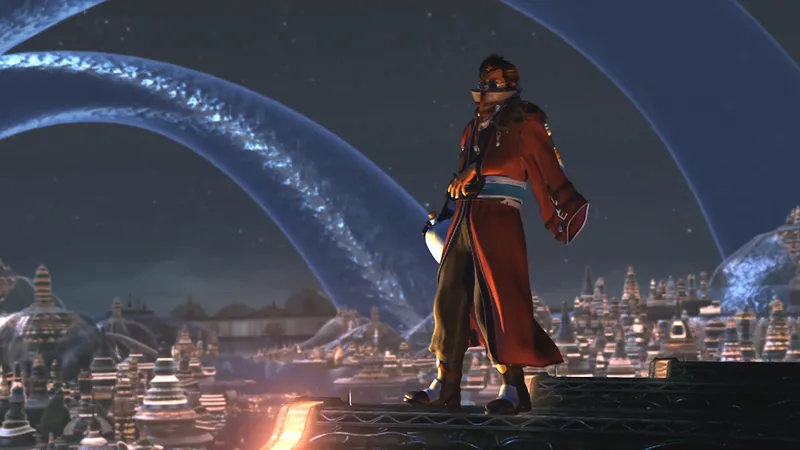
Tidus is polarizing — the voice, the shorts, the laugh scene — and I think that's exactly why he works. He's not a stoic hero. He's a loudmouthed athlete ripped from a futuristic city and dropped into a world that runs on prayer and resignation. His city, Zanarkand, was destroyed a thousand years ago. Nobody believes him. Nobody knows his name. He's confused, homesick, and carrying the weight of an absent father who abandoned him — and he processes all of it through stubborn, cocky energy that refuses to match the somber world around him.
That mismatch is the game's secret weapon. Tidus asks the questions that everyone in Spira is too afraid or too conditioned to ask. Why does Yuna have to die? Why does everyone accept this? Why is there no other way? The player needs these questions because Spira's culture — its death-worship disguised as religion, its cyclic sacrifice presented as hope — is designed to be accepted without challenge. Tidus is the crack in that acceptance, and the game is structured so that his ignorance becomes your education.
The Pilgrimage: A Road Trip Toward Death
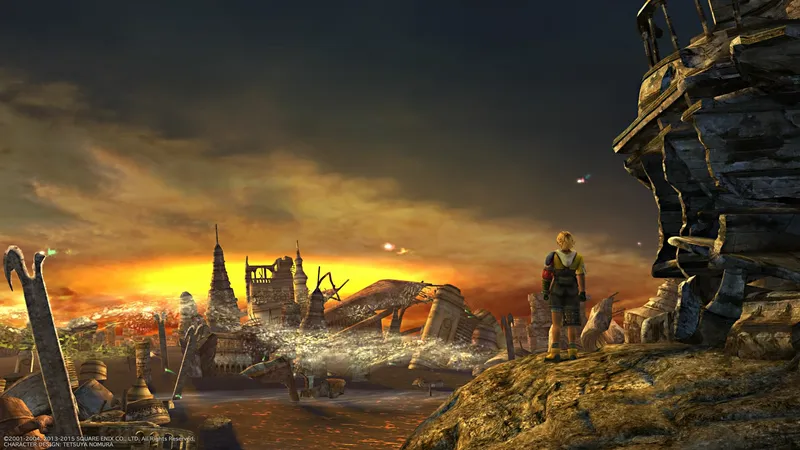
Final Fantasy X is a road trip to the end of the world, and the game never lets you forget where it's heading. Yuna — the summoner whose pilgrimage structures the entire journey — is walking toward her own death. She knows it. Her guardians know it. The player figures it out gradually, through temple prayers and village whispers and the way Auron stares at nothing when someone mentions "the final summoning." The genius of FFX's pacing is that every beautiful vista, every warm campfire scene, every laugh between party members is shadowed by the knowledge that this journey has an endpoint, and that endpoint is sacrifice.
The world design reinforces this. Spira is presented as a linear pilgrimage path — Besaid Island, Kilika, Luca, the Mi'ihen Highroad, the Thunder Plains, Macalania — each location distinct in atmosphere but connected by the same forward momentum. There's almost no backtracking. You walk forward because that's what pilgrims do. The linearity that people criticize in FFX is thematic. You're not exploring an open world — you're walking a funeral procession and calling it an adventure, which is exactly what Spira's people have been doing for a thousand years.
Between gentle piano presses and electronic synth, through flatlands and ethereal forests and snowy canyons, the detail of Spira's suffering state is sincere. Repetitive dogmas, constant rebuilding, priests and villagers who bow deeply before Yuna's service — and then the Sending scene in Kilika. Yuna toes atop the dead bay, twirling her staff in ceremonial fashion, weaving her body with the water as a Gregorian hymn carries a spiritual drum. The scene is somber, even creepy. A wrongness difficult to shake.
The Conditional Turn-Based System: Clarity as Design
FFX's combat system replaced the Active Time Battle with something slower and more transparent: the Conditional Turn-Based system (CTB). A timeline on the right side of the screen shows you exactly who acts when and how your actions affect the order. Haste pushes you forward. Slow pushes enemies back. Every decision has visible consequences before you commit. After years of ATB systems where timing created artificial urgency, CTB felt like the series finally letting you think.
The party swap system is the other stroke of genius. Any character can tag in or out mid-battle, and ability points are awarded to anyone who participates. Auron's armor-piercing blade handles heavy enemies. Wakka's thrown ball targets flyers. Lulu's elemental magic exploits weaknesses. Rikku dismantles machines. Tidus casts Haste on everyone. The result is a matching game — pair the right character to the right enemy — that makes every party member feel essential rather than decorative. Boss fights demand your entire roster, tossing potions, swapping formations, and earning their cinematic finishers through genuine tactical play.
The Sphere Grid — FFX's character progression system — makes growth visible and customizable. Instead of invisible experience points, you physically move nodes along a branching board, choosing stats and abilities with each step. Characters start in their own lanes but can eventually cross into others, creating hybrid builds that reward long-term planning. It's the most satisfying leveling system in the franchise after FFV's job system.
Death Pervades Everything
It pervades Final Fantasy X. The same souls Yuna lifts from lifeless bodies also appear in combat, slipping from fallen foes as each kill releases their waning screams. Thematic connectivity resides in everything in Spira. Villains who refuse death, who seek power in it, who abuse the cycle — they create questions that only Tidus, in his naivety, is willing to ask. Party members serve as satellites to Spira's culture rather than individual points of focus. Rifts between their beliefs begin to fade as each discovers their relatable goals of happiness.
Yet it's a happiness feigned. The game's plastic optimism permeates through its characters, flashy combat, and time-draining sidequests — Blitzball tournaments, monster hunts, Chocobo races accessible from any save point. You can ignore the world and the fate of its people, just as they do. But eventually it must be faced. As friendships grow, the very skill grids of characters intermingle, strengthening your party for a decisive battle against a world rigged with demonic motives.
The Ending: Earned, Devastating, Perfect
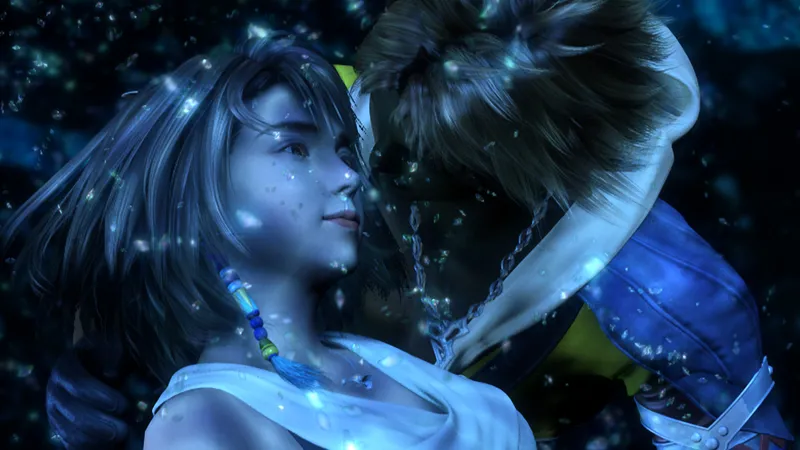
I'm not going to spoil FFX's ending in 2026. If you haven't played it, you deserve to experience it clean. What I will say is this: the reason the ending works — the reason it still makes me tear up on playthrough four — is that the game spent sixty hours walking you toward it. Every temple, every Sending, every quiet moment between Tidus and Yuna on the Macalania spring was building toward a conclusion that is simultaneously inevitable and shocking. You know where this is going. You've known since Kilika. And when it arrives, it still breaks you.
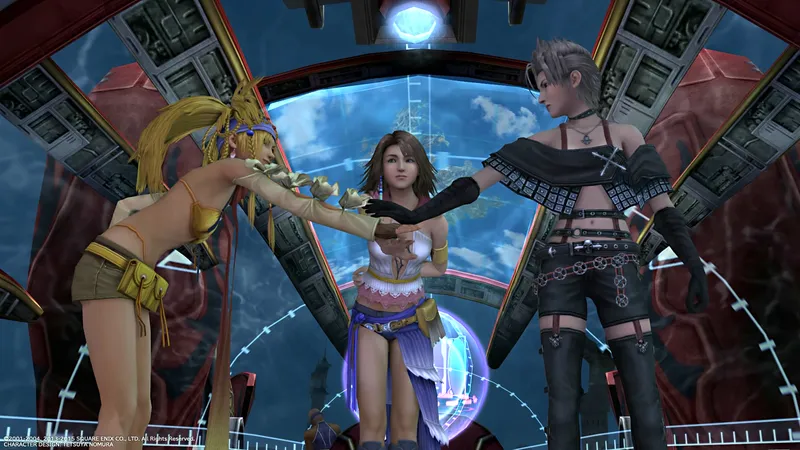
The boss theme scrambles with chaotic electric guitar and wailing chords, but underneath, a steady crash of cymbals guides you from the chaos. It builds tempo, crashing faster until it drops at the very point the party runs onto the battle screen. Yuna clutches her staff to her chest. Tidus rocks a sword confidently. Rikku practically jams to the soundtrack. She throws up the first Hastega, the spell effects wash over the party, and an uplifting sense of challenge floods through you. Your party stands prepared to turn the tables on Death itself.
Final Fantasy X is the most structurally perfect game in the franchise. Not the most ambitious (that's FF6), not the most stylish (that's FF7 Remake), not the deepest (that's FFT). But no other Final Fantasy builds its world, its characters, its themes, and its combat into a single unified experience as effectively as FFX. It earns its tears. It earns its ten out of ten. And after twenty-four years, it earns its place as a game I will never stop replaying.
Play it. On whatever platform you have. The HD Remaster is available on PlayStation, Switch, Steam, and mobile. There's no excuse left.
All images are official screenshots from Final Fantasy X/X-2 HD Remaster. Final Fantasy is a registered trademark of Square Enix. Originally published April 2016. Updated March 2026.
10/10 is right, my good man. Much like Final Fantasy 6, 7, and Chrono Trigger, Final Fantasy X is one of those games that I play once a year without fail. The graphics, the voice acting, the storyline; it was all gold. I know people like to make fun of the “laughing scene,” hell I even make fun of the laughing scene. But those people and myself that give it guff probably haven’t played through the game or didn’t watch it to the end. Tidus and Yuna are two characters that we rarely see in gaming anymore: deep, relatable, and human. This is a game that everyone who loves RPGs must play. Period.