
The original Final Fantasy was based on a gamble. When Hironobu Sakaguchi pitched the game, he named it Final Fantasy since he believed it would be his final chance to create a game. The first installment of the series did not create JRPGs, but it did create the necessary elements that would define the genre for the next three decades and pave the way for one of the most successful franchises in gaming history. Little did Squaresoft know that the 1987 release of Final Fantasy for the Famicom would be a game they would gamble on. This review will focus on the original 1987 game and the 2026 Pixel Remaster.
To see how the JRPG genre grew parallel to the rise of Final Fantasy, one needs to look at the history of JRPGs, starting with Dragon Quest, which released its first game in 1986. This review will focus solely on 1987’s Final Fantasy, isolating it to its own entity, to examine the overall design and structure of the game, its story, its music, and the legacy that transformed it from just another Famicom title to a true classic.
The Birth of a Final Fantasy
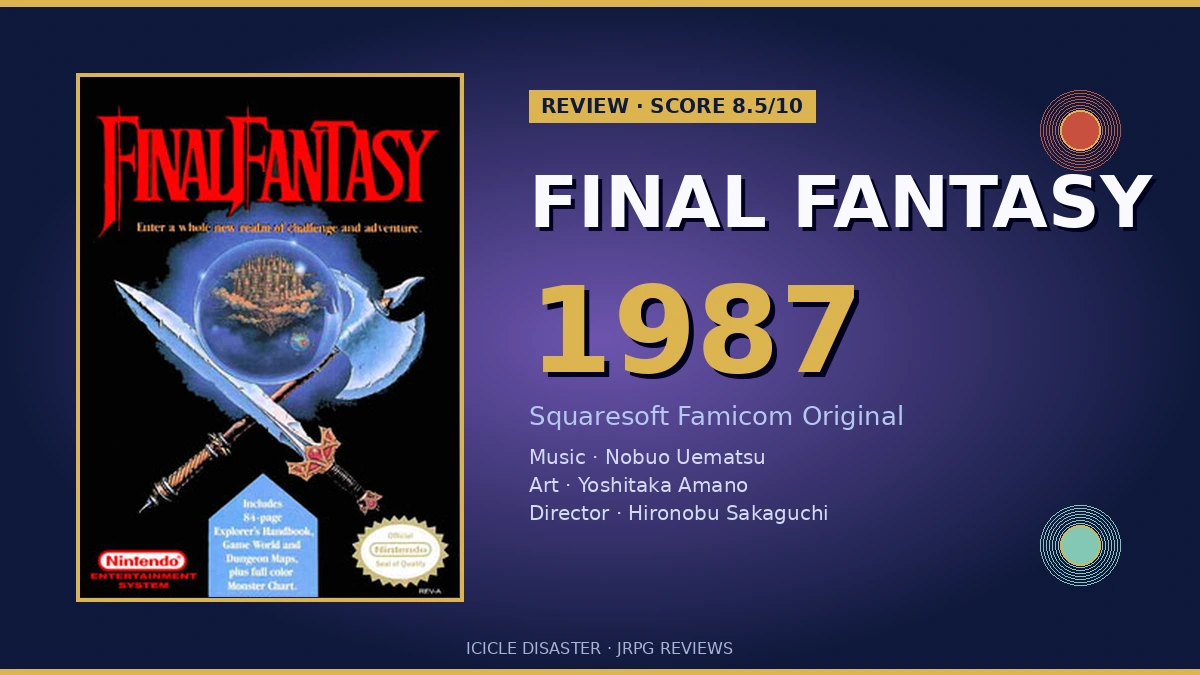
The beginning of the Final Fantasy franchise is quite well-known. Squaresoft was in trouble after multiple failed games and going into the 1987, they needed a hit or they would go bankrupt. After seeing the success of the game Dragon Quest, employee Hironobu Sakaguchi decided to pitch a game that would rival that game and win big. He proposed a game in the style of Dragon Quest, and it got approved. The company took a risk and put 7 employees to work on the game with Sakaguchi as the director. His team included notable figures such as composer Nobuo Uematsu, character designer Yoshitaka Amano and programmer Nasir Gebelli.
The title Final Fantasy was a play on both words. Squaresoft was on its final leg and the team thought this would be the last game they ever created. Sakaguchi also mentioned in interviews that the abbreviation worked nice in Japanese and the company was on Final terms with their budget so it was fitting. The game was released on the Famicom in Japan in 1987 and sold 400,000 copies, saving Squaresoft from going out of business.
When creating the game, the team had to think inside the limits of the Famicom. The team had 256kb for programming and 64kb for character data so they had to do a lot of creative compression. The turn based combat, 4 character party, overworld exploration, and the dungeon delineated town structure all stemmed from the lack of capabilities in the Famicom. The challenges shaped the experience players felt from their design.
Story, Setting, and the Light Warriors
In 1987's Final Fantasy, players began their journey in the kingdom of Cornelia, where they met four unnamed heroes. Each hero carried one of the four elemental orbs that had recently lost their light. Each player gets to name the heroes, and choose their job classes before the journey begins. At this point in time, the story explains that Princess Cornelia has been captured, and a fallen knight named Garland is the one holding her hostage. The heroes must rescue her, establishing the tone for the game. The game does a great job using unique story telling techniques. Instead of a cutscene or some voice acting, and while there is some expository dialogue, there is little of it. Most of the narrative is told through the player's interactions with NPCs and the environment.
Upon defeating Garland at the Chaos Shrine and rescuing the princess, the Light Warriors discover their true quest. They must defeat the four fiends that have captured the light from each of the four orbs. Each fiend correlates with one of the four elements: Earth, Fire, Water, and Wind. Each of the elemental dungeons contains one of the fiends and serves as a vital checkpoint for your journey. Each of these dungeons rewards you for exploration, setting clear story objectives while avoiding forcing you to follow a set path. Once you progress to the mid game, you are able to access previously unreachable areas of the map using your airship and canoe. The game world remains open even after the by the four fiends.
What sets Final Fantasy 1987 apart from other games of that time period comes from the narrative surprise encountered in the endgame. After defeating the four fiends and restoring the orbs, the Light Warriors go back in time to the Chaos Shrine. There they learn that Garland — the knight the Warriors defeated at the beginning of the journey — was sent back in time by the Four Fiends. He becomes Chaos, the main villain of the game, who uses his powers to send the Four Fiends forward in time, who then send Garland back in time. The Light Warriors are challenged to complete this time loop by defeating Chaos in the past to end the cycle. For a Famicom game in 1987, that type of reasoning was very advanced and established a benchmark that the later Final Fantasies like VI, VII, and X would continue to use and expand upon. For further analysis on the evolution of storytelling in Final Fantasy throughout the games in the series, there are multiple entries in our analysis of JRPGs with the best stories that build directly on the structural foundation established here.
Combat, Classes, and Character Progression
The combat mechanic in Final Fantasy 1987 is based on traditional turn-based systems where players give commands at the start of a round and all combatants’ turns (friendly or enemy) are determined by speed stats. Each party of four players has a front and back row system in which melee classes are in the front to take damage and spellcasters are in the back to avoid damage. Although this system may seem simple, it adds a degree of complexity when compared to Dragon Quest which does not have this system and only has one or two player parties.
Character class selection happens only once at the start of the game, and this selection determines the entire gameplay experience as each of the six starting classes (Warrior, Thief, Monk, Red Mage, White Mage, Black Mage) performs a unique function. Warriors do melee damage. Thieves provide fast escape options. Monks do unarmed damage and their damage scales as they level. Red Mages are spellcasters with a few spells from each school of magic, but are flexible in roles. White Mages and Black Mages only do healing and protective spells or offensive spells of a single element, respectively. Each class can be upgraded to a stronger one during the middle of the game through a class change ceremony at the Castle of Ordeals, changing Warriors to Knights, Black Mages to Black Wizards, etc.
The magic system does not use the MP pool system that later Final Fantasy games use. Instead, spells are structured around charges, wherein each character has a fixed number of spells per charge level. Casting a spell will consume a charge of that spell's level. This means the player will be encouraged to save their spells for harder boss fights rather than use their powerful spells carelessly. Each spell has to be individually bought from magic shops, which are placed around the world map. Players will want to explore the world map more because each spell they buy creates a unique character build, which adds to the game. While the original Famicom version has a punishing enemy encounter rate, the player will be rewarded for grinding their level as they will gain more combat abilities in addition to their existing ones.
World Design and Exploration
The world of Final Fantasy from 1987 includes a large mainland that can be traversed by foot, however, additional parts of the world can be explored by the player once they have acquired water and air travel. In the first phase of walking travel, the player can only explore the town of Cornelia and a few story-related thn locations such as the Marsh Cave, Pravoka, and the Western Keep. After defeating the pirate Bikke, players can then use the boat to explore more of the coast. Upon obtaining the airship halfway through the game, the players can freely travel around the world at their desire.
For dungeons in this game, Final Fantasy looks to its predecessor, Dragon Quest, to understand the conventions for designing dungeons. Verticality is added to dungeons in this game by adding floors. The Earth Cave, Gurgu Volcano, Sea Shrine, and Sky Castle all have different enemies as well as different obstacles and treasures that players can find. The original Famicom version of the game makes it so that if players want to run through a dungeon, they need to spend hours at a time because there are no save points in the dungeons. The more modern edition of the game, called the Pixel Remaster, is more forgiving as it added a save feature that takes away some of the frustration of dungeon runs. The core flow of the dungeons remain unchanged.
There is a story to tell in the geography itself. You start off the continent and eventually get to scattered islands you can only access by ship. As for the elemental shrines, they can be found thematically as to what they are. Earth Shrine is inland as you could guess, Fire Shrine is in a volcano, for Water Shrine, it is deep underwater, and lastly Wind Shrine is in a castle that is floating. This simple environmental storytelling shows a pattern that JRPGs would use for years. The first JRPGs to utilize the geography combined with the themes of the game were Squaresoft games and ever since, it has been an expectation. Our coverage of best JRPGs from Square Enix with Chrono Trigger, Final Fantasy and all other games in the line demonstrates all the games that best follow this expectation.
Music and Sound Design
In 1987, Nobuo Uematsu was tasked with composing the soundtrack for Final Fantasy, the first entry in what is now one of the largest and most influential franchises in gaming history. He created about twenty individual pieces to accompany the first Final Fantasy game, though each had to be specifically tailored to the limitations of the Famicom console. The Famicom was only able to handle audio through two pulse waves and a triangle wave, along with a noise channel. Given these restrictions, Uematsu had to emphasize melodic ingenuity over harmonic diversity. The end result showcases his talent for producing distinctive pieces, even with these strict boundaries. The Prelude, which consists of flowing, arpeggiated notes, is now one of the most famous and frequently reused pieces of music in gaming history. Due to its popularity, it has become a tradition to include it in the soundtracks of each new Final Fantasy game.
Overall, the soundtrack is composed of a limited number of tracks that each have accompanying loops that give variety to the score. The themes for the battle, overworld, and town areas are the foundational pieces of audio that will be heard most often. Each of the battle themes provides variation that avoids becoming tedious during the multiple hours of playtime required to complete all of the encounters. The melody of the overworld theme captures the adventurous spirit of exploration that is crucial to the gameplay. Finally, the themes from Matoya's Cave, the Elf Prince, and the Chaos Shrine help to provide tonal diversity that prevents the soundtrack from growing tedious, despite the small number of tracks available.
The Pixel Remaster edition lets players choose between the original Famicom audio and a version arranged by Nobuo Uematsu. Uematsu’s arranged version adds orchestral sounds and other enhancements to the audio, while still keeping the melodies that made the original songs great. The original Famicom audio also has a following because of its authenticity, while newer fans of the soundtrack seem to prefer the arranged versions. Regardless of preference, the music in Final Fantasy 1987 will always be regarded as one of the most important soundtracks in video game history, and as time went on, Uematsu’s importance to the series only grew.
Visual Design and Yoshitaka Amano
Character and monster designs for Final Fantasy in 1987 by Yoshitaka Amano set the standards for how future games in the series would create visual representations of their characters without experimentation. Amano's watercolor illustrations of the Light Warriors, the Four Fiends, and all of the supporting characters were used in promotional material, official guidebooks, and even cartridge packaging. His unique, otherworldly style that used emaciated characters, flowing vestments, and weapons of elaborate.
Final Fantasy's in-game sprite work is expressive and imaginative while staying within the strict limitations. Fighter sprites weapon and armor based on their class, which would evolve visually when the player upgraded their weapon or armor. Not all of the sprites used for the random encounter monsters were visually different; the ones used for Garland, the Four Fiends, and Chaos were bigger and had different designs compared to the other dungeon sprites. Environmental themes were reinforced in dungeon tilesets by using different colors in the tilesets. Brown rocks in the Earth Cave, red lava in the Gurgu Volcano, blue sea depths in the Sea Shrine, and white cloud architecture in the Sky Castle.
The Pixel Remaster uses a new higher-res art style with a wider color palette, but maintains the same feel as the original. Characters gained new animation frames, enemies were given a few more details, and dungeons were updated with effects such as water and torches. In the gallery mode, remastered versions of Amano's character illustrations can be viewed alongside the original artwork for the first time at a higher quality. If you like the pixel art style, check out our best pixel art JRPGs where we feature Final Fantasy and other classic games from the genre.
The Pixel Remaster Treatment
Over 2021 and 2022, Square Enix published the Final Fantasy Pixel Remaster collection, with the first title in the collection, Final Fantasy, coming out July 2021. The Pixel Remaster collection will be the most modern way to play Final Fantasy in 2026, as it will take over previous versions such as the WonderSwan Color, PlayStation's Final Fantasy Origins, Game Boy Advance Final Fantasy I and II Dawn of Souls, PSP 20th Anniversary Editions and various mobile ports. The Pixel Remaster maintains the original design of the game, and focuses on improving quality of life enhancements which improves the experience without compromising the integrity of the original.
Some of the most notable features of the Pixel Remaster titles are an automatic battle system for easier encounters, adjustable encounter rates, the ability to save your game in more locations, as well as a complete bestiary, a music player that allows you to choose between the original and remixed versions of the games soundtracks, and a gallery of Amano's illustrations. The menu and interface has also received a total overhaul which includes larger text, cleaner menus, and perfectly scaled graphics for modern displays. Thankfully the Pixel Remaster avoided the issues that some previous remakes have had like the Dawn of Souls and 20th Anniversary editions which added new dungeons and gameplay outside the scope of the original. The Pixel Remaster stays true to the 1987 experience while refining the elements that truly need it.
Square Enix launched the Pixel Remasters on PC via Steam, mobile devices, PS4, and Nintendo Switch. The collection's release on Switch in 2023 made this collection even more convenient for handheld use and the short JRPG sessions that classic games encourage. Pricing is different by region and platform, but considering the impact of the games in question, the complete bundle of Pixel Remaster Final Fantasy I-VI is one of the best priced JRPGs available. For those noticing how the franchise evolved through its mainline numbered entries, every Final Fantasy ranked goes from the 1987 beginning of the series through to the latest Rebirth release.
Reception, Legacy, and Cultural Impact
When Final Fantasy began its long-lasting journey in 1987, its first stop was Japan and it was received warmly there. Publications like Famitsu gave positive reviews mentioning the music and the story, as well as the overall scope. The game, however, needed to be adjusted for Western cultures which took three extra years and saw it release in 1990 in North America for the NES. This gave the game a more muted reception as the critics and fans didn't have the same warm reception as the game that came before it. North America sold around 700,000 copies, which would build a fanbase for the franchise that would expand as time went on and more games were released in the series Final Fantasy.
The first game received small profits, but gave the company large returns in the years to come as they began a rivalry with Enix, another major developer for JRPGs. The game also began a franchise starting with 15 main entries and in time creating a collection of games, movies, anime, and even concerts that is still going. The game also set conventions that would be used for years in the genre like 4 person parties, job classes, elemental boss battles, and airships as endgame transport.
The 1987 title is also historically relevant as it fits between the foundational JRPG template established by the original Dragon Quest, and the later experimental narratives of Final Fantasy IV, V, VI, and so on. While Dragon Quest focused on accessibility with a single player hero's journey, Final Fantasy 1987 brought forth the genre defining elements of multiple party members, a choice of class and role system, and a sort of 3D heavenly body narrated story (as opposed to the metaphysical tales spun by contenders like Myst) that advanced the genre's storytelling maturity into the 1990s and 2000s. Those who are looking into the wider RPG discourse will see how our best RPGs of all time coverage situates Final Fantasy 1987 among the most significant titles across all platforms and all decades of the genre.
Where to Play Final Fantasy 1987 Today
The 2026 edition of Final Fantasy 1987 is best experienced through Pixel Remaster, as it offers the same price and features as its competitors. For example, the Steam Edition features cloud saves and achievement integration, along with keyboard and controller support. Additionally, the PlayStation 4 edition features PlayStation 5 backward compatibility and trophy integration. The Nintendo Switch edition allows players to use their Joy-Con and Pro Controller, as well as play in handheld mode. The Android and iOS mobile editions offer greater flexibility to players for play on the go but use less responsive Touchscreen controls for menu navigation. To see the most up-to-date pricing and information for platform-specific purchase comparisons, check the Steam store page for the Final Fantasy Pixel Remaster.
Those who wish to keep the original Famicom experience intact can use the Nintendo Switch Online service. It offers Japanese-languaged navigation to access the Famicom version of Final Fantasy and 1987 experience. This experience includes authentic save limitations, original chiptune audio, and true old-school encounter rates. The fact that Famicom originals are legally accessible to players is a massive preservation milestone for those who relied on unlicensed access in decades past.
Dawn of Souls, 20th Anniversary editions, and early mobile port versions are out of date and/or out of print legally obtainable versions of Final Fantasy. Square Enix has positioned these versions of Final Fantasy as legally obtainable versions, and their own Final Fantasy site directs users to the Pixel Remaster collection instead of the older versions. For fans of Square Enix to best anticipate releases in the wider JRPG calendar, most anticipated JRPGs of 2027 includes upcoming titles from the publisher as well as the genre.
Final Verdict
The original Final Fantasy was released in 1987 and is highly regarded as one of the most important JRPGs in history. The original Famicom release along with the Pixel Remaster edition set standards in gaming for thirty years, preserving the original design while implementing quality of life improvements. Even in 2026, the time-loop narrative twist is still impactful and the four-character party system adds tactical depth that modern JRPGs struggle to achieve. Nobuo Uematsu's contributions to music set a standard for future entries that no other games have surpassed in popularity and recognition.
The original 1987 version is a little dated and shows its age when compared to modern standards in JRPGs. In the Famicom version, the encounter rate can be grinding and the story is lacking in modern narrative expectations. The character classes do not have the depth that later Final Fantasy games added and in some of the dungeon designs your patience will be tested. Most of these gripes are addressed in the Pixel Remaster edition as it has added adjustable difficulty and other quality of life improvements; however, the design from 1987 that has been left untouched will show its age, and newcomers should prepare for that.
With the Pixel Remaster edition set for release in 2026, new players will have the opportunity to experience the game as it was originally intended. Players can take nostalgia for history and enjoy a simple walk down JRPG lane. Those with gaming historical knowledge can appreciate the game's genre-defining mechanics that many successors have replicated. Customers can appreciate the game's components designed by many industry-defining benchmarks, Nobuo Uematsu (music), Hironobu Sakaguchi (director), and Yoshitaka Amano (character designer), and Nasir Gebelli (lead programmer). The JRPG gaming nostalgia can be compounded for players of the site's best Square Enix JRPGs, best played at the End of History to appreciate the quality of the game's defining creators. Uematsu has been particularly attached to the franchise. The game forms the foundation of the franchise, and Uematsu has been attached to the franchise for nearly 40 years.
Score: 8.5/10. Strongly playable and recordable, the Pixel Remaster is the best way to play the game in 2026.