
Assessed across a full playthrough of all eight character storylines, the true ending, and multiple job builds — not a preview build or partial run — Octopath Traveler 2 is one of the best turn-based JRPGs of the current generation. That's not a hot take; it's just the honest conclusion after 70-plus hours with it. The game has a real structural problem at its center, and I'll get into it. But the question in the title — does the gameplay loop justify the fractured story? — has a clear answer: yes, mostly, and more convincingly than the original managed.
The Verdict Up Front: Is Octopath Traveler 2 Worth Playing?
Yes. If you have any tolerance for turn-based combat and classic JRPG pacing, Octopath Traveler 2 earns a strong recommendation. It's a better game than its predecessor in nearly every dimension that matters, and in 2026 it remains one of the clearest examples of Square Enix's HD-2D label delivering on its aesthetic and mechanical promise.
The caveat is real: if you play JRPGs primarily for a unified, character-driven narrative — the kind where your party members actually talk to each other and share a story — Octopath 2 will frustrate you. The eight protagonists largely live in their own bubbles. That's a structural choice, not a flaw the developers overlooked, and it shapes everything about how the game feels over a long playthrough.
For JRPG veterans who prioritize combat depth and world-building over narrative cohesion, this is close to a must-play.
What Octopath Traveler 2 Gets Right: Gameplay and Combat Loop
The combat system is the engine the entire game runs on, and it holds up across a 60-to-80-hour playthrough better than most turn-based systems do. That's because it's built around active decision-making rather than stat accumulation.
The Boost and Break System in Practice
The Boost and Break system is the backbone: every enemy has a set of weaknesses — weapon types and elemental affinities — and hitting those weaknesses chips away at a shield counter above their health bar. Break that counter to zero and the enemy is staggered, losing their next turn and taking amplified damage. Boost Points, which accumulate each turn up to five, let you multiply your attacks or abilities to hit multiple weaknesses at once or dump damage during the break window.
This creates a genuine tactical loop. Do you spend BP early to break a tough enemy faster, or bank it for a burst turn? Do you front-load your damage dealer's Boost on a staggered boss, or save it for the next wave? Those decisions stay interesting across the full game because bosses keep raising the complexity ceiling — new shield counts, new multi-phase patterns, new status mechanics.
The system doesn't reinvent turn-based combat. It executes on its own logic with enough consistency that repetition doesn't set in the way it does in shallower RPGs.
Jobs, Latent Powers, and Build Depth
The job system adds the second layer. Every character has a primary class and can equip a secondary job from a shared pool, plus access to hidden "advanced" jobs found through exploration. The combinations create real build variety — not the illusory kind where every party ends up looking the same by hour 40.
Latent Powers are where the system gets character-specific. Each protagonist has a unique resource mechanic that charges during battle and unlocks a powerful ability: Hikari can steal enemy skills through a dueling mechanic, building a personal arsenal of moves no other character can access. Temenos, the cleric, can strip additional weakness shields from enemies through an interrogation Path Action outside of battle, giving him unusual utility in specific fights. These aren't cosmetic differences — they meaningfully change how you slot characters into your party composition.
The depth is real. Whether you choose to engage with it fully or just run comfortable setups is up to you, but the ceiling is high enough to reward experimentation.
Story Structure: Eight Characters, One World, Zero Crossover (Mostly)
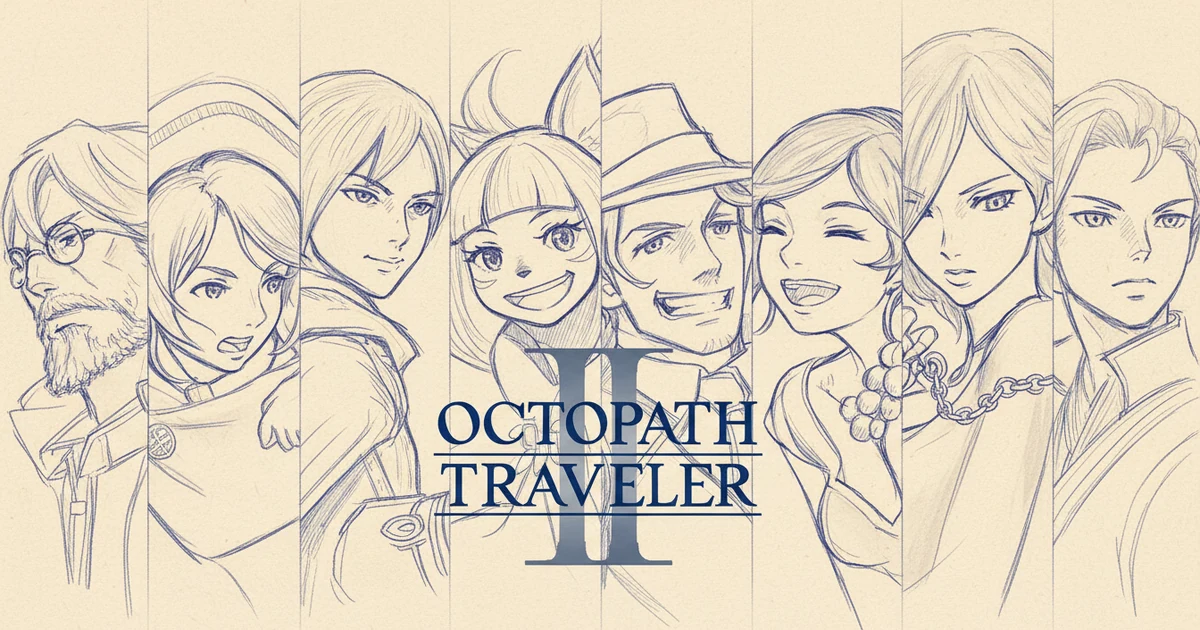
Each of the eight protagonists has a four-chapter story that plays out largely independent of the others. You recruit everyone into your party, but the other seven characters are silent passengers during any given protagonist's chapter. It's a deliberate anthology structure, and it has a cost.
The Best and Worst Individual Stories
The range in quality is wide. Throné's story is the standout — a revenge arc about a thief raised in a murderous guild, with a clearly defined antagonist, a coherent emotional throughline, and a final chapter that actually lands. It's the most novelistically satisfying of the eight. Osvald's academic revenge plot is similarly focused: a scholar framed for the murder of his family escapes a prison island to hunt down the man responsible. The dark tone is earned, not decorative.
On the weaker end, Partitio's merchant story about disrupting capitalism is earnest but thin, and Agnea's dancer arc chasing her dream of performing on the grand stage is pleasant without being particularly compelling. Neither is bad — just notably lighter than the best the game offers.
How Octopath 2 Improves on the Original's Narrative Weakness
The original Octopath Traveler offered no answer to the isolation problem beyond a secret final chapter that most players missed. Octopath 2 does more work here. Crossed Paths are two-character side-stories that pair protagonists together and let them actually interact — these are some of the best writing in the game. The true ending, which requires completing all eight main stories, adds a convergence that gives the world shared stakes it otherwise lacks.
These additions don't fully solve the structural problem. The eight stories still don't weave together in any organic way during the main playthrough. But they're a meaningful improvement over the original's near-total narrative isolation, and they show the developers understood the critique.
Octopath 2 vs. Octopath 1: Is It Actually Better?
Straightforwardly, yes. The gap isn't enormous, but it's consistent across every system that matters.
The day/night mechanic is the biggest quality-of-life upgrade. Each character now has two Path Actions — the world-interaction abilities used outside combat — one available during the day and one at night. This effectively doubles the toolkit compared to the original's single-action-per-character design. Osvald can mug NPCs at night; Temenos can guide them during the day. It makes exploration feel more flexible and the world more dynamic.
Latent Powers didn't exist in the original, and their absence was felt. Having a character-specific resource mechanic gives every protagonist a combat identity beyond their job class. The writing is also sharper across the board — the worst stories in Octopath 2 are better than the worst in Octopath 1.
The structural problem — eight isolated narratives, a party that doesn't behave like a party — remains. Octopath 2 patches around it better than the original did, but it doesn't fix it. If that was your primary complaint about the first game, the sequel will reduce the frustration without eliminating it.
Performance and Platform: Switch vs. PC vs. PlayStation
Octopath Traveler 2 runs well on all three platforms. The PC version on Steam is the cleanest experience technically — higher frame rates, resolution options, and no performance compromises. PlayStation 4 and 5 versions are solid, with the PS5 running the game without issue.
The Switch version has a strong argument despite being the least powerful platform: Octopath 2 is built for portable play. The chapter structure, the session-to-session pacing, and the HD-2D aesthetic all translate naturally to handheld. Minor framerate dips exist in the Switch version but are not disruptive. If you already own the game on Switch, there's no urgent reason to double-dip.
For a first purchase in 2026, PC is the optimal version on raw performance. Switch is the right pick if you play portably.
Who Should Buy Octopath Traveler 2 — and Who Should Skip It
Buy it if: You're a JRPG veteran who values combat depth, wants a long game with a high mechanical ceiling, or has any interest in the HD-2D visual style. You don't need to have played Octopath 1 — the stories are completely separate. Buy it if (newcomers): You're new to turn-based JRPGs and want a system that's approachable but not shallow. The Boost and Break loop teaches itself naturally. Just go in knowing the narrative is anthology-style, not a single unified story. Skip it if: Your priority is a tightly written party narrative where characters share a story and develop relationships across the whole game. Octopath 2 isn't that game, and no amount of Crossed Paths side-content changes its fundamental structure. Skip it for now if: You bounced hard off Octopath 1's story isolation and were hoping the sequel fixed it entirely. It improved it. It didn't fix it.On any ranking of HD-2D titles or JRPGs on Switch, Octopath Traveler 2 sits near the top of both lists. Directed by Keisuke Miyauchi under Square Enix's HD-2D label — the same framework now powering Dragon Quest III HD-2D Remake — it's also a useful reference point for understanding where that aesthetic is headed as a long-term commercial bet.
Final verdict: A-tier JRPG. The gameplay loop justifies the commitment. The story structure is a real limitation, not a dealbreaker.
If you're deciding where Octopath 2 fits in the broader picture, check out our ranked list of the best JRPGs on Switch and our HD-2D games tier list — both updated for 2026 and the natural next reads after this one.