
The Famicom version of Final Fantasy II came out in 1988, and it is known for being controversial since the previous Final Fantasy game saved Square from bankruptcy. The design choices for this game divided critics since it still is one of the most controversial design choices nearly four decades later. The original game set the standard for what JRPG games have to do, and how they need to be constructed. However, instead of following those expectations, Final Fantasy II changed the formula completely by introducing experimental mechanics that were used later in the SaGa series. Some of the more notable ones were a cast of character's that had a story, keywords to drive conversations, and skills that would progress instead of levels. These created a divide among the community since some people enjoyed the new take while others felt it was a step in the wrong direction.
The review looks at Final Fantasy II from its 1988 release on Famicom, its several remastered versions from the modern Steam Pixel Remaster and Switch, the Soul of Rebirth bonus content from the Game Boy Advance era, and the upcoming editorial reassessment Final Fantasy II will be getting in 2026 as the franchise turns 40. The score takes into account the very real shortcomings of the original release, as well as the historical importance that makes Final Fantasy II a must experience title for any serious JRPG fan. The verdict balances the then contemporary 1988 experience and the modern Pixel Remaster experience for players who missed Final Fantasy II during its original release to appreciate the design philosophy that influenced two parallel franchise traditions.
The Story of Firion and the Empire of Palamecia
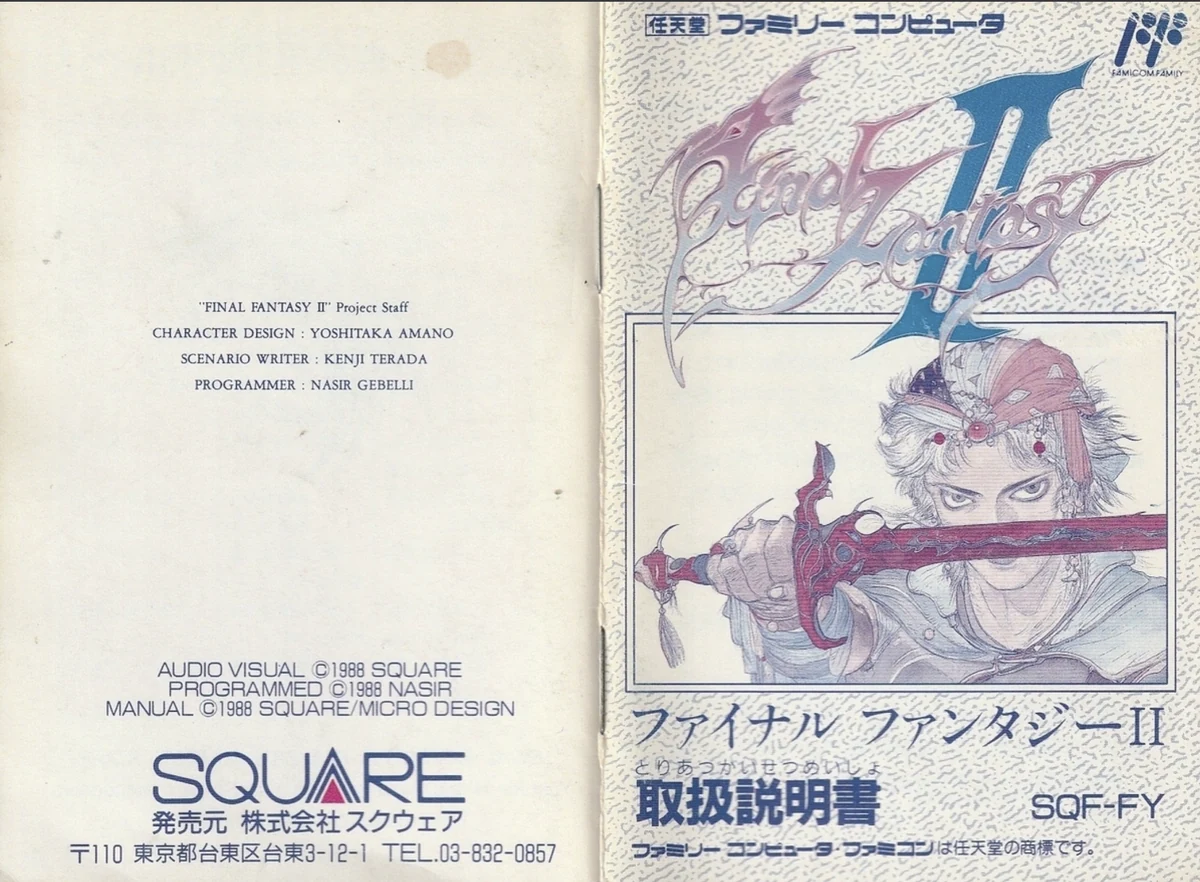
The initial sequence of Final Fantasy II has our four heroes, Firion, Maria, Guy, and Leon escaping the city of Fynn just as the Empire of Palamecia is about to take control of the city. The four friends are defeated by the game's antagonists in a pre-determined loss, which sets the stage for the game's primary antagonistic force. Leon is separated from the remaining three members of his group, and shortly afterward we meet Princess Hilda of Fynn, who takes care of the three heroes and helps them join the resistance of the Empire's domination of the world map. The narrative scope improved from what was shown in Final Fantasy I, where the four Light Warriors arrived as completely quiet protagonists with no defined backstory, history, or character development aside from their assigned duties with the elemental crystals.
The character-centric narrative that Final Fantasy II established became a foundation that all successive mainline titles of the series would expand upon. Final Fantasy IV would build on this with the Cecil redemption arc, Final Fantasy VI would build on that to include multi-character narratives, and Final Fantasy VII would bring that same legacy to the world of 3D gaming with Cloud Strife at the center of that storyline. Although the 1988 version may seem rather simplistic by today's standards, the character driven story narrative was a real departure from the rest of the pack and gave the series its first real identity, putting it ahead of the contemporary Famicom JRPGs of that time, such as Dragon Quest II.
The Empire of Palamecia antagonist structure also pioneered the franchise's first imperial-evil framework, which would return in Final Fantasy IV (Baron Empire), Final Fantasy VI (Gestahlian Empire), Final Fantasy IX (Alexandria), and Final Fantasy XII (Archadian Empire). The narrative template Final Fantasy II established was more influential than the game’s mechanical experimentation, and the historical context justifies why the franchise retains the game despite its harsh reception. For broader context on how JRPG narratives evolved from the genre's origin through its modern releases, jrpgs with the best stories covers the foundational ranking that includes Final Fantasy II and its contribution to the storytelling tradition.
Skill-Use Progression and the SaGa Series Prototype
In Final Fantasy II, the most debated design choice was the total absence of conventional level-up progression. In lieu of traditional leveling, Square chose to implement a 'skill-use' mechanic where player actions dictated the stats that would be improved. For example, physical attacks would improve a party member's Strength and maximum HP, while spells would increase a character's Spirit and MP (this mechanic was known as 'magic' in the earlier titles). Additionally, HP would increase as the character would take damage. As for weapon skills, proficiency would increase based on the weapon used and not the character. This design choice was in stark contrast to the level-up system established by the Dragon Quest series as well as the first Final Fantasy. It was also a system akin to the SaGa series which director Akitoshi Kawazu would create as a spiritual successor to Final Fantasy II.
This design decision ultimately rewarded players who understood the mechanics of the game as the system was unforgiving to those that approached the game with the traditional open world expectations that many of the early JRPGs had. This meant that the infamous meme of characters attacking one another to increase their HP became quite common as there was no natural progression to the system, which made experimentation more of a requirement than an option. Players who conducted random encounters and repeatedly hit the ‘attack’ button were doomed to underperform as the battle system had an upper bound limit on what difficulty the party could face. In contrast, players who ‘exploited’ the system and farmed specific skills to their desired endpoint could essentially 'break' the entire game.
The use of skills connects JRPGs to the tradition of character progression found in most other role-playing games. Many modern JRPGs—like SaGa Frontier, Romancing SaGa, and the modern SaGa Emerald Beyond—have a form of character progression that goes back to the experimentation of Final Fantasy II. The Final Fantasy games also incorporated hybrid versions of these mechanics, including the skill-use mechanics in later games, such as the Junction system in Final Fantasy VIII. For an example of franchise-wide character progression systems that evolved beyond simply assigning levels, the best JRPGs with job class systems examines the parallel tradition that was established by Final Fantasy III and its alternative to skill-use progression. These two systems represent the two paths that Square could take after the experimentation of Final Fantasy II: either the path was a success or failure, depending on the player perspective.
The Four-Character Party Without a Hero Stat
Final Fantasy II had a party system that featured three permanent members and a rotating fourth slot that was filled by various story-related characters as the game was played. During some of the game's first chapters Minwu the white mage joined, and when the party reached the Salamand mountain quest Josef the warrior was part of the group. Also, during the Salamand assault, Gordon the prince was a member of the group. The fourth member being a story-related character reinforced the story as it took away player agency. This is very different from the first game in the series, Final Fantasy, where the four Light Warriors in the party could not be changed, and there were also no story-related connections when choosing their classes or jobs at the beginning of the game.
When compared to Final Fantasy I, the rotating party member system created emotional moments in Final Fantasy II that the earlier game avoided. Josef's death during the escape sequence of Pandaemonium was without a doubt one of the earliest character deaths in JRPG history. The death was used for narrative weight and not to contribute gameplay. Losing the character forced the player to suffer the emotional consequences with no chance for a resurrection. The dramatic moment prefigured Aerith's death in Final Fantasy VII, and for almost a decade, it established that Square would treat character deaths not as a temporary game mechanic, but a serious narrative instrument. The 1988 design certainly felt the constraints of the Famicom's limitations, but the ambition far exceeded the contemporary JRPGs of the time.
The Keyword Conversation System
In many towns, NPCs (non-player characters) had unique keywords that were necessary to unlock advanced conversations, quests, or further game progression. To obtain these keywords, players had to engage with NPCs and pay attention to the keywords. Many keywords had nothing to do with a quest, but spoke to the investment the developers took in crafting the story. The three recurring keywords, “Wild Rose,” “Mythril,” and “Cyclone,” are perfect examples of keywords players had to learn in order to progress the game. These keywords were essential to advancing the quest line or else players were left feeling stuck.
These keywords intertwined with the JRPG (Japanese Role-Playing Game) genre and many future games drive dialogue such as “Lufia II” and “Suikoden II.” It was innovative in its time for a video game to push players to engage with the story for gameplay mechanics instead of using story elements as just a vehicle to push gameplay forward. This innovation would be lost in “Final Fantasty III” as it would rely on the more traditional systems of dialogue trees. The ability to integrate story and gameplay.
Soul of Rebirth Bonus Content
The Game Boy Advance Dawn of Souls collection Final Fantasy II Soul of Rebirth bonus campaign has Minwu, Scott, Josef, and Ricard travel to the afterlife to follow them as they try to find peace after dying in war. They added this to give closure to character arcs the original game left open and the bonus campaign had production quality to match what Square was doing with GBA Final Fantasy titles. Dawn of Souls was the first time Final Fantasy I and II were bundled together on a portable device and Soul of Rebirth was the bonus that added the most worth to the GBA version compared to previous re-releases.
The Pixel Remaster editions launched on Steam, Switch, PlayStation and Mobile in 2021 and removed Soul of Rebirth, a choice that many deemed controversial, during this period of modern remastering. To completely experience Final Fantasy II, players must have either the GBA Dawn of Souls cartridge or the PSP Anniversary Edition that also had Soul of Rebirth. The choice to remove Soul of Rebirth set the bar lower for completionists, but it made it clear what the thinking was for Pixel Remaster – they wanted to be true to the original Famicom release and choose authenticity over the bonus content added after the fact.
Pixel Remaster Edition and Quality of Life
The Pixel Remaster Edition came out in 2021. This is the easiest way to play Final Fantasy II, available on Steam, Nintendo Switch, PlayStation 4, and iOS/Android. The remaster has updated pixel graphics that are true to the original Famicom graphics, a remastered orchestral soundtrack by the original composer of the game, Composer Nobuo Uematsu, and arranger Hiroyuki Nakayama. The remaster also included better autosave and save features, fast-forward, monster info menus, and an auto-battle feature. The remaster changed Final Fantasy II from a historical curiosity to a playable modern game.
The Pixel Remaster scaling difficulty option allowed players to experience the 1988 game without the grinding that was necessary to progress in the game. This meant players could experience the story and all of the game’s mechanics without the redundant tasks that players from the Famicom era would have to do. The Pixel Remaster edition also included a bestiary and a music player that helped Famicom players understand the original developers' intentions and decisions about the game that they may have missed during their time playing the game.
The best pixel art JRPGs explains the design philosophy that inspires modern indie games. Many modern games like Octopath Traveler and Triangle Strategy use Final Fantasy II as a reference.
The Critical Reception Then vs Now
In 1988, critics said that the story was complex, but the system used to execute skills was messy and hard to understand. Because of this and many other issues, the game was released exclusively in Japan during the original launch of the game, waiting until the the 2003 release of Final Fantasy II in the PlayStation Origins collection to be sent west. This meant that players in the West who loved JRPGs at the time only played the game after experiencing a multitude of sequels in the Franchise, including Final Fantasy IV which sets the standard for the franchise. Once Western players began playing Final Fantasy II, they began to realize that the game fell far shorter than the recent multiple successors to the game. In Japan, when the game was originally released, players had context for the game and the experimentation released in 1988. This was not the case for Western players when this game was released and they faced historical gaps with out context making the game feel of abysmal quality.
Because of the brave narrative, a new style of play, and the multiple other narrative elements in the game, critics and players alike began to recognize the game for what it was – revolutionary to the genre and, unlike other games of its time, correct in its experimentation. Many praise the games design choices today and gameplay mechanics and stories continue to inspire franchises. The Pixel Remaster raised its score to above 70 on Metacritic further supporting the games historical value along with the limited gameplay and the many quality of life improvements that have been made.
Musical Score by Nobuo Uematsu Continued
Nobuo Uematsu came back to compose Final Fantasy II after his work on the original Final Fantasy, and the 1988 score expanded his range greatly. The Rebel Army theme set the precedent for the empire-resistance music that Uematsu would continue to refine with his Empire themes in Final Fantasy VI and the Shinra themes in Final Fantasy VII. The Princess Hilda theme showed Uematsu’s ability to create memorable character themes in the limited audio range of the Famicom, while the Pandaemonium boss theme set the standard for the kind of dramatic orchestration that would later be built on in Final Fantasy IV with the SNES sound capabilities.
The Pixel Remaster edition made arranged versions by Hiroyuki Nakayama (under Uematsu’s supervision) that changed the original Famicom synth into orchestral versions. This Pixel Remaster gave players their first chance to hear music from Final Fantasy II at a production level comparable to the original Final Fantasy VII soundtrack, making the remaster worth it even for fans who already owned previous versions of Final Fantasy II. For franchise wide composer context, all Final Fantasy ranked lists cover Uematsu's contributions to the mainline entries he scored from Final Fantasy I to Final Fantasy IX before passing the torch to others for the later entries.
Where Final Fantasy II Fits in 2026 JRPG Canon
Final Fantasy II serves as an important example in contributing to the development of Final Fantasy's narrative-driven games and the more experimental SaGa games. It marks an interesting point in time for JRPGs as it is the first experimental game in the franchise and shows how far the franchise has to go. It contains some storytelling features that were far ahead of its time for the Famicom era such as story-driven character development, skill progression systems, and keyword conversations, but also some very primitive features that have led to it receiving an unfair amount of criticism. The primitive and advanced features caused both defenders and critics to be very passionate about the title, especially for the amount of criticism it received for its low amount of sales compared to the other entries in the series.
Modern games such as Final Fantasy XVI Empire of Bahamut and the Final Fantasy VII Remake feature the same themes as the narratives present in Final Fantasy II. Those who want to understand modern day Final Fantasy games and aren’t fan of outdated gameplay will be able to appreciate the Pixel Remaster. My review references the original BGR retrospective for the historical context that I used to inform parts of my review. For a series-wide ranking that places Final Fantasy II among the mainline entries, every Final Fantasy ranked surveys the franchise from Famicom origin through PlayStation 5 era to place Final Fantasy II.
The review this piece is paired with covers the original Final Fantasy 1987 review, which reflects the basis that Final Fantasy II both was built upon and reacted against. Those patrons of the Famicom-era Final Fantasy series who wish to experience the games in the order of their release should play Final Fantasy I, then Final Fantasy II, and finally Final Fantasy III to see the variation in design that Square experimented with prior to Final Fantasy IV, which established the design template that all subsequent mainline titles would refine. This chronological method highlights design lessons that are still present in the modern releases Final Fantasy XVI and Final Fantasy VII Rebirth.
Final Verdict — Where Final Fantasy II Earns Its Place
Final Fantasy II deserves a `7.5/10` score for JRPG fans who enjoy historical relevance, story ambition, and creative game systems as opposed to refined mainstream JRPG mechanics. As of 2026, the skill-use progression system continues to be divisive, the same as it was in 1988. Players expecting a traditional experience from Final Fantasy II will be disappointed and likely frustrated because of the missing mechanics. The Pixel Remaster versions provide some accessibility, removing the most grinding requirements of the original Famicom release, but the philosophy across all editions that prioritizes design experimentation over refinement remains unchanged.
Score: 7.5/10. Even if gameplay is frustrating when compared to newer titles, the legacy, ambition, and foundation building of the SaGa franchise makes Final Fantasy II a title that must be played by dedicated JRPG fans. For accessibility purposes, 2026 will be years away from the Pixel Remaster (2022) edition, and the Dawn of Souls and Anniversary Edition of the PSP are the only remaining ways to get the completed Soul of Rebirth bonus content. For context regarding the franchise’s width within the 2026 JRPG calendar, best RPGs of all time provides the foundational ranking that situates Final Fantasy II along the genre's greater timeline, while best Square Enix JRPGs encompasses the wider publisher catalog that Final Fantasy II helped to pioneer. For best pixel art JRPGs, along with covering the context of future JRPGs that may be developed within the Final Fantasy framework, most anticipated JRPGs of 2027 lists announced titles that may carry the design philosophy that the Pixel Remaster series is part of called the Remaster series. The companion coverage of the Starbites review is the indie JRPG equivalent to this review that focuses on AAA Final Fantasy, and the history of JRPGs is the wider genre evolution tracing that Final Fantasy II was an experimental second installment in the franchise.