
Final Fantasy VI Pixel Remaster will be available in Xbox Game Pass on June 2, 2026, with access via Game Pass Ultimate, Game Pass Premium, and PC Game Pass subscriptions. The game will be available for all subscribers. It will be their first opportunity to try the game, in a subscription service format, since it was artistically and critically acclaimed as the pinnacle of 2D graphics for the Final Fantasy franchise back when it was released on the SNES in 1994. For subscribers, it will also be one of the most significant offerings in 2026 when it becomes available to play in Xbox Game Pass as a classic JRPG. It will also be available to play at no extra charge for gamers that did not play previous re-releases or did not play Final Fantasy VI previously.
We will also analyze and explain what will be added to Xbox Game Pass on June 02, 2026, the reasons Final Fantasy VI has earned and kept the genre-defining label for 31 years, how the Pixel Remaster differs from previously released game versions, the character Kefka and how he is portrayed as a villain, the story and character conditions that separate this game from other contemporary JRPGs, the analysis of the ATB combat system, how Game Pass will compare to the out-of-pocket costs of purchasing the game, and how Final Fantasy VI will fit in the overall JRPG game offerings slated for release in 2026. For ATB context in broader genre, see best JRPG battle systems. Our position on the Final Fantasy franchise is Editorialized in every one of our Authority ranked hubs for every Final Fantasy franchise Final Fantasy game released, and it ranks VI among the complete mainline series.
The June 2 2026 Game Pass Addition — What's Included Across Tiers
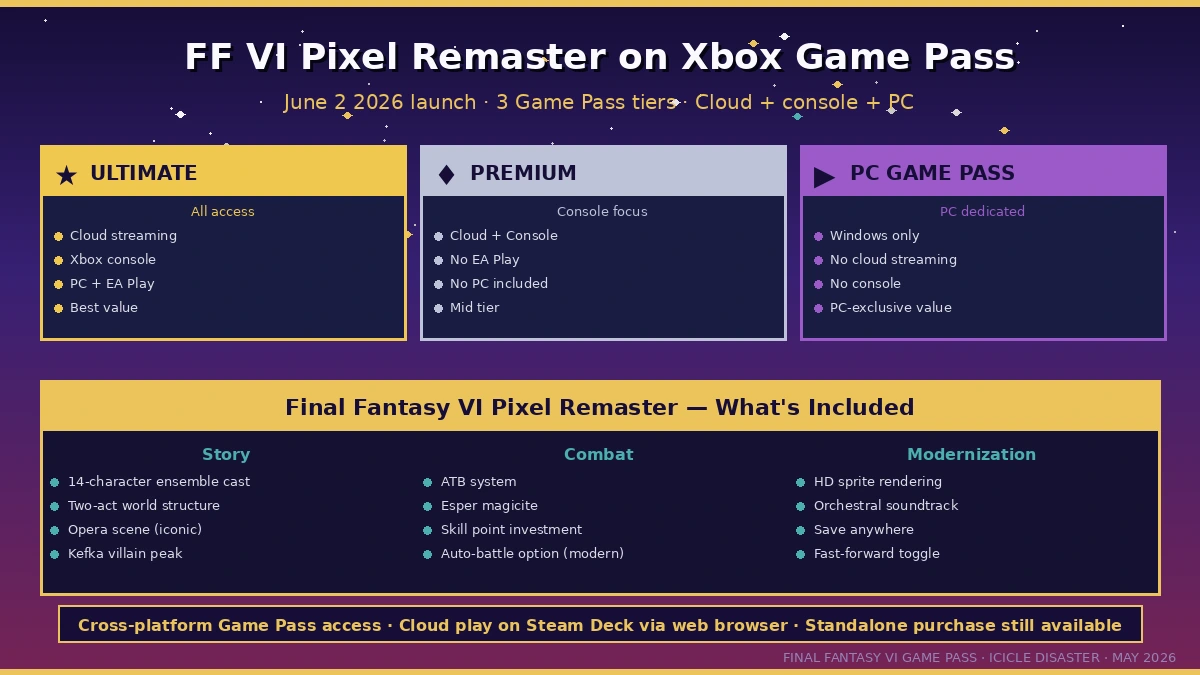
On June 2, 2026, Final Fantasy VI Pixel Remaster will be added to Xbox Game Pass. The three subscription tiers available for Game Pass will allow access to the same content. Game Pass Ultimate subscribers will get access to the broadest bundle, which includes cloud streaming, Xbox console access, PC access, and EA Play. Game Pass Premium subscribers will have equal access via the cloud and console. PC Game Pass subscribers can access the content only on Windows PC. Game Pass does not offer differing tiers or versions for the Pixel Remaster content.
Game Pass also adds the Final Fantasy VI Pixel Remaster game content without the standalone purchase limitations for game content that players have experienced, especially those who own multiple Final Fantasy Pixel Remaster games on Steam or the Nintendo eShop, but did not buy Final Fantasy 6 Remastered. It makes the game available for those who want to assess gameplay quality of Final Fantansy VI Pixel Remaster game before they buy the game for Nintendo Switch, PlayStation, or Steam. The decision aligns with the ongoing release strategy of Square Enix’s partnered back-catalog releases with subscription services alongside their active development of Final Fantasy XVI and the Final Fantasy VII Remake trilogy.
In order to understand the Steam Deck and Xbox cloud streaming options, as well as the broader context for Game Pass and JRPGs, our buying guide for the Steam Deck explains the decision-making process for access to cross-platform JRPGs through subscription services. With the addition of Final Fantasy VI Pixel Remaster to Game Pass, players can access Game Pass titles through the Xbox Cloud Streaming service without having to own an Xbox console.
Final Fantasy VI as Genre Benchmark — Why "Greatest JRPG Ever" Holds Up
The positive emphasis on the Final Fantasy VI as the “greatest JRPG ever made” should not be viewed simply as score aggregation nostalgia. The game introduced the format of ensemble casts consisting of four teenage leads. Each had their own distinct story with a fine-grained balance of operatic tragedy and comedic antics set within a coherent structure. The second half of the game introduced a world transformation that would go on to be emulated by every JRPG on the SNES. Are the critics of 2020s covering modern games still claiming that Final Fantasy VI had design ambitions outside the capabilities of the Famicom and early NES console JRPG library? Did the games released after Final Fantasy VII (arguably the franchise’s most popular release until Final Fantasy VII: Remake) inherit, rather than surpass, the narrative scope of Final Fantasy VI? The opera scene in the game is easily one of the most technically and narratively ambitious scenes in JRPG history. The 1994 SNES sound chip was able to render a fully operational, staged, and synchronized performance as an operatic performance within the game. Not only this, but player-controlled dialogue selection influenced the scoring in a way that would not break the audio sync that the scene relied on to achieve its full potential. The character relationships revealed by the narrative integration and advancements in plot earned the scene along with its technically executed design recognition across numerous subsequent game franchise releases spanning over 3 decades.
To better understand the genre where we place Final Fantasy VI in the entire RPG canon including Western releases, the best RPGs of all time foundational ranking encompasses the contemporary critical conversation that VI's reputation continues to shape. The franchise-wide ranking at every Final Fantasy ranked places VI in the appropriate tier relative to other mainline entries including the modern Final Fantasy 1987 review of the original 1987 Famicom release that started the series, and the Final Fantasy II review of the 1988 experimental sequel.
Kefka as Franchise Villain Peak
Kefka Palazzo is easily one of the best antagonist designs in the series, and probably the most influential in the history of JRPGs. For genre context on JRPG antagonist canon, see best JRPG villains. What sets him apart is that the player gets to experience what no other Final Fantasy main villain has: a defeatist victory. Instead of Kefka being defeated and resetting dude's world, this antagonist actually wins and turns the world into one of desperate nihilism. While Sephiroth from Final Fantasy VII is the nostalgic go to classic villain, Kefka actually becomes the franchise icon for being one of the only antagonists to achieve victory during the campaign. From that point on, the game switches to a world of resistance and fights against order instead of following a hero through a series of rising action fights against the villain.
Kefka has influenced modern JRPG villain design more than most coverage gives him credit for. His own combination of comedic malice, dreadful nihilism, and true narrative success set the stage for many other franchises' villain designs, including Persona and Tales of. The demonic clown design in the Pixel Remaster clings to the spirit of the original SNES from the sister James settlement on Kefka. This design also allows him to transcend that brooding bishounen template that later Final Fantasy entries embraced for their villain designs.
In order to understand JRPG villains and the genre, the best coverage on JRPG villains puts Kefka alongside current genre milestones and explains why he solidified his position as the peak of FF6 villains. Users of Game Pass who will be playing FF6 for the first time will thank the historical context that positions Kefka as a design inspiration rather than a simply an unforgettable villain.
The Pixel Remaster Edition vs Legacy Versions
The Pixel Remaster Edition is a strong contender for the most faithful modern representation of Final Fantasy VI's original 1994 design intents. For Square Enix, Pixel Remaster integrates the philosophy of the preservation of the original sprite work, while also including some selective modernizations which improves the accessibility of the game without replacing the artistic decisions of the developers that defined the game. The remaster, for example, replaces sprites to be compatible with modern high-resolution displays, offers both the remastered orchestral soundtrack as well as the original SNES version with a toggle option for the user to choose between versions of the soundtrack, and offers auto-battle, save anywhere, and fast-forward features that respect the player’s time, but also preserve the integrity of the original combat design.
When comparing the legacy versions of Final Fantasy VI, the Pixel Remaster clearly exemplifies what the modern route should be. The original SNES release of 1994 is still considered the artistic reference point, but it is a lot more difficult to obtain than the remastered versions due to the need for the original hardware or an emulator, while also suffering from GBA sound chip limitations, therefore, it sacrifices musical presentation versions compared to modern arrangements. The 1999 PlayStation Final Fantasy Anthology compilation had slow loading times as well as buggy cutscene rendering which made the entire experience much worse than the SNES original. The Game Boy Advance port of 2007 offered new bonus content, but audiowise it suffered from GBA hardware limitations. Finally, the Steam release from 2014 offered poor replacement of visual assets which the Pixel Remaster Edition was created to reverse.
Regarding the Pixel Remaster Series and the overall preservation strategy for 2D Final Fantasy games, the rank of the best pixel art JRPGs covers contemporary releases that build off the Pixel Remaster design philosophy. This includes HD-2D adaptations and indie pixel revival initiatives. The Pixel Remaster Series stands as one of the most successful classic JRPG modernization attempts in the history of publishing. In particular, Final Fantasy VI advantages from the meticulous sprite editing that retains the original artistic identity and eliminates the technical obstacles that prior re-releases imposed.
The ATB Combat System and Why 1994 Mechanics Still Hold
Final Fantasy VI's integration of the Active Time Battle (ATB) system was a major innovation in the history of JRPGs. The system replaces the traditional turn-based order with real-time gauge filling which generates a unique combat pacing pressure. ATB allows for a blend of real-time and turn-based systems in which a player is forced to make active tactical decisions while also providing the strategic depth of turn-based combat. The ATB system was originally created for Final Fantasy IV, but Final Fantasy VI was the first game to expand this system for multiple character classes which further increased the refinement.
In addition to the ATB system, Final Fantasy VI's combat also features the unique Esper system. This system allows players to equip magicite stones to characters and learn spells unique to each character. The game has a total of fourteen playable characters, increasing the variety of possible builds without assigning character classes. The Esper system rewards players for experimenting with different combinations of characters throughout the game's two-part story. The second half of the game actually encourages players to use characters together who were previously used in combat.
The ATB system was implemented in many modern JRPGs including Persona and Octopath Traveler. Final Fantasy VI's ATB system also influenced the later Final Fantasy titles until the series moved to action-based gameplay.
Where to Play — Game Pass vs Standalone Purchase
The addition of Final Fantasy VI Pixel Remaster to Game Pass on June 2, 2026, creates a crossroads for many players who do not already own it on other platforms. With a Game Pass subscription, it's the most cost-effective way to temporarily access the game so players can assess the quality of Pixel Remaster, complete the 30-40 hour campaign once, and move on to the next title without committing to that title in their permanent library. This title will be available for a one-time purchase via Steam, Nintendo eShop, or PlayStation Store, and that will give the buyer permanent access to their library and the opportunity to play it multiple times and enjoy the nostalgic replay value that Final Fantasy VI undoubtedly will bring.
The platform choice will also have an impact on certain practical aspects of the experience. The cloud streaming capability of Xbox Game Pass allows you to play it on phones, tablets, Steam Decks via browser, and any other device with an internet connection, but it does require a good connection. On the other hand, the Xbox console version gives you reliable performance without any network issues but you lose the ability to play it on the go. Game Pass on PC will work with modern hardware on Steam Deck via alternative client workflows and allows you to use your monitor and other devices which creates a lot of flexibility. Finally, the Steam Deck specifically should be noted for its portable design which fits right in with the session-based pacing of Final Fantasy VI and our best JRPGs on Steam Deck ranking covers the whole handheld JRPG space that the Pixel Remaster also fits into.
Physical collectors of JRPGs will be disappointed to learn that Final Fantasy VI Pixel Remaster will not be shipping as a standalone physical release. The Square Enix back-catalog physical edition collection travels through the Pixel Remaster series bundle releases that pop up on Nintendo Switch and PlayStation via limited-run distribution. Consumers wanting physical media will have to watch these bundle releases instead of hoping for individual VI physicals.
Final Fantasy VI in 2026 JRPG Canon Context
Final Fantasy VI has a special position in the JRPG history and the release calendar of Square Enix. Other titles in the franchise such as Final Fantasy XVI and VII Remake are still actively releasing updates while the remastered versions of the older games in the series are being released on Switch and mobile. This gives access to new players to experience the original title releases of the franchise. The latest addition to Game Pass on June 2nd is an example of the dual strategy of Square Enix. They are able to keep revenue coming in from AAA titles while also providing access to older titles with subscription services.
The 31 year anniversary for Final Fantasy VI shows why the title is still a frontrunner in the genre. Modern critiques consistently have VI ranked among the top titles in the franchise even after 14 additional titles have been added. This is not just based off of nostalgia. Critics who have played through the entire franchise have placed Final Fantasy VI in a notable position.
As we continue to cover the genre placing Final Fantasy VI within the wider 2026 JRPG context, we look at Chrono Trigger remake rumors as we consider the 1995 SNES sibling that shares development culture and design ambition with Final Fantasy VI, the every Final Fantasy ranked franchise hub gives the comparative rank across all mainline entries, and the history of JRPGs shows the genre evolution that VI's contributions continue to shape. To continue covering pixel art traditions, best pixel art JRPGs covers modern releases that build on the visual legacy of Final Fantasy VI. Best anticipated JRPGs of 2027 looks at announced titles that will likely be added to the genre canon conversation alongside Final Fantasy VI for looking ahead coverage including JRPG releases up to 2027. Original ScreenRant Game Pass coverage that informed parts of this analysis is accessible at the source article for context cross-reference. For genre context on JRPG antagonist canon, see best JRPG villains. For ATB context in broader genre, see best JRPG battle systems. For Steam Deck practical Game Pass access workflow, see our Steam Deck buying guide. For forward-looking JRPG calendar, see most anticipated JRPGs of 2027.