
Icicle Disaster has analyzed and rated over 250 JRPGs on all major platforms since 2017, with full playthroughs of each title on this list. That matters here because what comes next isn't constructed from Metacritic averages or a rehashed listicle — it's built from real hours in these games. And the repeated conclusion after all that time is this: the PS2 JRPG library is one of the most underappreciated collections in gaming history.
Why the PS2 JRPG Library Is Still Undersold
The best PS2 JRPGs? Most names are the same. Final Fantasy X, Final Fantasy XII, Kingdom Hearts, Persona 4, and Dragon Quest VIII. Franchise overview at every Persona game ranked. Franchise context in every Final Fantasy ranked. Those are good games, but their names and established franchises create a nostalgia hype machine. They are easy and safe.
The PS2 era was truly great, and there are so many more than just the five mentioned. For broader genre evolution context, see history of JRPGs. Companies like Atlus, Mastiff, and NIS America were bringing over dense JRPGs that were weird and without marketing. Competitors released first party games and they vanished from stores quickly. Gaming journalism wasn't built to save them, and it still isn't.
Each game on this list does something very different from the names. Someone who finished this game believes it is worthy of a recommendation.
Shadow Hearts: Covenant — The Best JRPG You Never Played
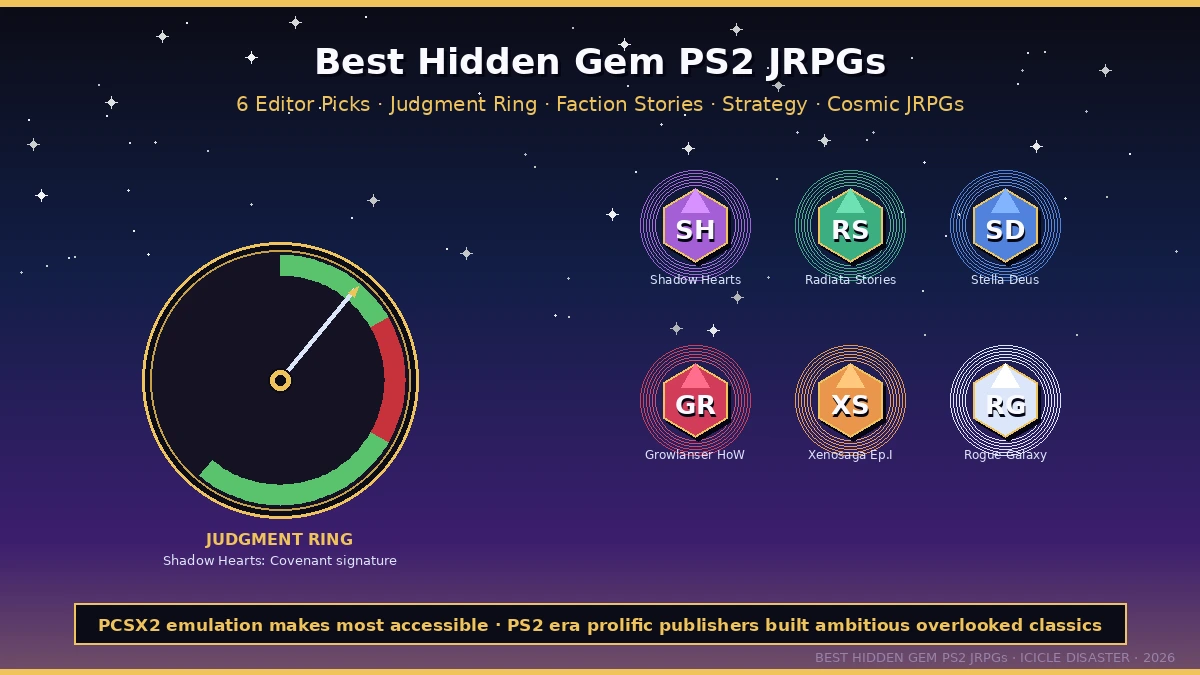
Shadow Hearts: Covenant is the most underrated JRPG in the history of the PS2. Not one of the most underrated, or in contention for most underrated. The most underrated. Not all that glitters is gold, and Shadow Hearts Covenant is a case of an underappreciated diamond in the rough, and the harsh reality is it most likely will remain hidden for the foreseeable future. Not all that glitters is gold, and Shadow Hearts Covenant is a case of an underappreciated diamond in the rough, and the harsh reality is it most likely will remain hidden for the foreseeable future. The game pairs absurdity with genuine horror and numbing violence, and their combination is both capable of and known to be jarring. The dark and satirical style does much to dampen the seriousness of the events going on, emphasizing the game's criticism of blind nationalism and the glorification of war.
Why Judgment Ring is One of a Kind
What sets it apart from countless other games of the era of the console it is on is the Judgment Ring combat system. It is a real-time assessment of a player's ability to click buttons (for each character, the number and position of the zones are predetermined, and the width of the zones varies, which determines how powerful the ability is, and whether or not the character is able to perform the ability at all. These abilities are locked, and the player can collect characters to learn additional abilities that modify the width of the zones (i.e. so they may be able to do things like create an ability that has a zone). The boss fights are no longer just a matter of whether or not the manager has cheese; they require actual managerial skills. It is a risky system where one player can create a boss fight where all of the players in the party must make an effort to achieve success. Because of this system, Shadow Hearts Covenant's battle system was able to reward players for each action taken, while turn-based combat systems still
Why It Never Found Its Audience
Covenant was published in North America by Midway, known for more mainstream titles like Mortal Kombat. They had no interest in marketing the title to the niche audience that would appreciate the game, nor did they have any means to address that audience. For example, they had less than ideal relationships with the necessary press outlets. So Covenant had almost no advertising before it was released and quickly faded into obscurity.
You should play the original Shadow Hearts (PS2, 2002) first since it is a direct sequel and features the same main character, Yuri Hyuga. Having that extra context will make the emotional ending of Covenant so much better. Covenant is built to be played on its own so don’t worry about the series order.
Read the complete Shadow Hearts: Covenant review for all the reasons why Covenant is worth your time.
Five More PS2 JRPGs the Algorithm Keeps Burying
Radiata Stories
It seems like enough excitement would be generated from a game where tri-Ace (famous for Star Ocean and Valkyrie Profile) helps to develop the game with Square Enix publishing. However, that's not the case here. This game has an outstanding cast of 300+ characters that can be recruited throughout the game. All of these characters have their own personalities and daily schedules. The game also features a split-faction story system. Depending on who you choose to ally with during the game, you will end up with a totally different experience in the second half of the game. This is quite an achievement for the PS2 JRPG genre, as very few games, if any, are willing to take large structural risks like this. Most people missed this game because Square Enix gave this game a very poorly timed (and poorly marketing) release with the Final Fantasy XII. Because of the lighthearted and cartoony tone, many players would dismiss this game assuming it was a kids game. That's too bad because it's great and not a kids game.
Stella Deus: The Gate of Eternity
Stella Deus is a tactical JRPG that has a complex and lengthy narrative. The tactical genre catalog is best tactical strategy JRPGs. The game immerses the player into a world that is slowly being devoured by a large miasma. The players will be forced to think critically and exert a high level of control regarding how they position their units, which units they use in conjunction, and how they manage their overall actions. All of these factors are very important to be successful in this game. Atlus decided to bring the title to North America in 2005, but decisions made during the publishing process would heavily hinder the success of the game. The limited printing run, niche publisher, and direct market competition would all combine to create the perfect storm that led to Stella Deus never receiving a second chance to prove itself.
Growlanser: Heritage of War
Growlanser: Heritage of War is the fifth mainline entry in a series that has never broken into the mainstream western audience. Despite this, the series has continued to show strong writing and real time strategy combat. The combat requires a fair amount of micro management and posiitioning which makes the decisions and outcome of battles worthwhile. As for the branching narrative structure, the choices the player makes impacts the storyline. As the PS2 was winding down, Atlus brought this game over as a successor to Working Designs. This means that by 2007 player interest shifted causing a decline in the audience. This game is highly recommended for players who want a story driven strategy game.
Xenosaga Episode I
Xenosaga Episode I has some baggage to carry. First of all it is super long and cinematic. There are abnormally high amounts of cutscenes and it is the first of a trilogy that never got the closure Tetsuya Takahashi intended. Regardless of these things the philosophical with the greatest ambition in the genre remains unmatched. The Gnostic, Neo, and Jungian influenced parts are the strongest of any other game. Namco's marketing missed the mark and went towards sci-fi which was not receptive to the real ideas. If Episode I is able to get to you, Episodes II and III are exclusive to PS2 and are worth it. Xenosaga Episode I has also received a digital release making it more easily accessible than the other games on this list.
Rogue Galaxy
Rogue Galaxy is an action JRPG that features a unique real-time space pirate theme, created by Level 5 and showing the great scope and ambition of the developer. It features a massive crafting system and factory-creation system that is immersive when compared to other titles on the platform. It was released in North America in 2007 and was released during a difficult period for gaming titles. The PS3 was heavily marketed and many titles were competing for limited space, and the consoel was nearing the end of its lifecycle. Sales suffered regardless of the positive reviews and quality the game received. The game was later digitally released to PS4, making it the most easy-to-obtain game on this list for players to access. It's a long game and knowing what you're signing up for helps, so read the full Rogue Galaxy review before committing.
How to Play These Games in 2026
The access image is uneven, but it is an improvement.
The easiest option to get Rogue Galaxy is on the PlayStation Store for PS4. You can buy it, download it, and then play it. Xenosaga Episode I is also available, giving you another option to get it legally. Just check the PSN for your region, as the availability of games differs from country to country.
There is also Shadow Hearts: Covenant, Radiata Stories, Stella Deus, and Growlanser. Unfortunately, games come out with big gaps between official re-releases, and secondary markets for legal copies of games have really high prices because the games are sought after. Covenant and Radiata Stories in particular have buy-in collector premiums which make obtaining a copy very much a worthwhile investment.
Most players are best off using the open-source PS2 emulator PCSX2, which has reached a state of compatibility and accuracy such that the vast majority of the PS2 JRPG library will run at full speed and without game-breaking problems on relatively weak modern PC hardware. It's the most realistic way to engage with games without an official re-release, and every title on this list is playable on it. You will need to obtain a PS2 BIOS file legally, which requires ownership of the console; however, the experience of emulation is the best way to play these games outside of original hardware. You will get upscaled resolution, full controller support, save states, and the ability to play a game on a modern PC as opposed to an ancient PS2.
If you want to use the original hardware a PS2 that has been soft modded or has Free McBoot is a good option. The hardware is cheap; the games are not.
What to Play First If You're New to PS2-Era JRPGs
Your goals for gaming experiences determine the best entry point.
If you want story and immersion first: The best one to begin with is Shadow Hearts: Covenant. The setting is unique, and it has the most distinctive narrative voice out of all others. There is also a very engaging combat system, and all three combined create a great experience for players spanning many hours. Then, if you want to continue playing more, I recommend playing the first Shadow Hearts game despite the fact that for most players, the chronology works best when played in reverse. To help you make the final decision, check out thefull review.
If you want strategy and systems first: The best choice would be more than the average weight destinies story branching and combat puzzle game viscerally strategic feel to demand combat enough to Heritage of War out of Growlanser.
If you want scale and spectacle first: This is to say that with Xenosaga episode I you are committing to a long narrative setup, and with Rogue Galaxy you have the alternative if you bounce off cutscene density in the first few hours of Galaxy Rogue it delivers scale through story real time combat and exploration without dense narrative. The payoff is real but it does require patience.
Before you start Radiata Stories, specifically, I recommend you read the review because of the earlier than most split game choice faction that divides most players. Expecting it to change players' approach to how they tackle the first half of the game.
These games represent the most interesting side of the PS2 JRPG library. While the well-known titles are familiar for a reason, these games show the more bizarre and ambitious side of the era.
For forward-looking JRPG coverage including announced 2027+ releases, see most anticipated JRPGs of 2027. For a 2026 indie JRPG review with similar deep-cut energy, see Starbites review. For the sister-platform deep-cut guide, see best hidden gem JRPGs on Switch covering modern Switch picks. For broader cross-platform underrated coverage, see most underrated JRPGs. The full comparative ranking that contextualizes these PS2 picks is at best RPGs of all time. For Judgment Ring comparative context, see best JRPG battle systems. The tactical genre catalog is best tactical strategy JRPGs. For an AAA action-RPG review counterpoint, see Crimson Desert review.