
Icicle Disaster has gone through, ranked and reviewed more than 250 JRPGs since 2017. Dragon Quest XI — covered in our every Dragon Quest game ranked franchise overview — is one of twelve to get a full play through. This was done on PS4 at launch, then again in the S Edition on PC. That context is important. The question here isn’t about if Dragon Quest XI was worth it to play in 2018, the question is if it earns your time in 2026 when you have a backlog with titles like Persona 5 Royal (covered in every Persona game ranked), Final Fantasy XVI (positioned in every Final Fantasy ranked) and everything else that came out since. The answer is yes and it’s not even close.
The Short Answer (Verdict First)
Yes, play it. For the S Edition, available on PC (covered in steam-pc/">best JRPGs on Steam PC), Nintendo Switch (see best JRPGs on Nintendo Switch), and PS4/PS5 (backwards compatible), I recommend getting it on the Switch. Avoid the base PS4 version if you can; the S Edition is the complete experience and the only version worth recommending at this point.
As of 2026, Dragon Quest XI S: Echoes of an Elusive Age – Definitive Edition remains one of the most complete JRPGs on the market. It’s not some cult oddity or a nostalgia trip. It’s a fully-fledged AAA-budget title and deserves to be called one of the best. It’s genre-defining. It comes highly recommended for players who enjoy a long and richly detailed story, a proper party, turn-based combat that does not pander to the player, and a game with a final act that justifies the hours you invested. This is not based on Metacritic scores, it’s from someone who finished the game twice.
What Kind of Game Dragon Quest XI Actually Is
Before all else, make sure you know what you are buying. Dragon Quest XI is not experimental. It does not try to reinvent the wheel. It is not Dark Souls-related, not open world busywork, and has no political subtext. It is pure JRPG comfort food on an AAA scale - classic hero's journey, large cast, world map, towns with NPCs to talk to, turn-based combat that has been refined over the last thirty years of the franchise.
Combat and Paced
Combat is traditional turn-based and has a party of up to four from a total of eight companions. Each character has a defined role and a skill tree called the Deftness Panel which gives you meaningful build options without requiring too much in the way of min-maxing. Regular fights are resolved quickly. Boss fights require you to pay attention to party composition and item usage. The system does not try to be an action game, and that is a strength, not a concession.
Pacing is deliberate. The main story takes 60-80 hours, longer if you do side quests and post-game content. The first part of the game builds the world and the party. Then the mid-game opens into more complex territory. Veterans who have played JRPGs that are more mechanically demanding may feel the early chapters drag. That friction is real, but it is structural, not sloppy. The game is building toward something big, and it pays off.
Who's Stalking The Luminary?
This story follows the Luminary, the hero of an ancient prophecy. Unfortunately, the world is mostly against him. The warmth of the script, earnestness, and occasional self-aware humor makes it seem like there is a developer kit at work. For the entire Dragon Quest series, the use of Akira Toriyama is prominent and consistent. Each game adapts this art style, and exemplifies it in a modern and sincere way. Dragon Quest XI expresses this to the fullest.
This game has a second half, and without spoiling it, the second half is one of the strongest 3rd acts in the entire genre. The game rewards players who were paying attention. It makes the deliberate pacing of the first act worth it.
Why It Holds Up in 2026
Additions in the S Edition
Besides visuals and performance, the S Edition has many new features that make it worth the price point. Orchestrated music can be played with the original synthesized score. The S Edition has Japanese voice acting along with an English Dub. An entirely new 2D mode is added, which is based on visuals from the Super Famicom era of Dragon Quest. This means that long-time fans of the series will have a new way to experience the same story. The most notable addition is Tickington which is an entirely new story arc that will revisit places from old Dragon Quest games. This adds many hours of gameplay on top of an already substantial game.
All of these features were added to the game for free and were not sold as a season pass or as part of a post launch content drop. Dragon Quest XI is one of the few modern AAA size JRPGs that is completely finished at launch with no day one patches, cut content, or battle passes. You pay once and the game is complete.
Visuals and Performance Now
Dragon Quest XI S runs cleanly on PC on hardware that is several years old. Because the art style is Toriyama’s designs in 3D, it ages better than realistic graphics because it is stylized and doesn’t chase realism. On Switch, the game compromises on resolution in handheld mode, but the visual style still looks good. Performance is smooth on PS5 through backward compatibility as well. None of the versions of this game feel broken or outdated, which is always the case for JRPG’s from the same time period.
Steam users have continued giving positive reviews for Dragon Quest XI S. This shows that the potential for people to replay the game and recommend it to others is strong even after the game has been out for a while.
Where It Struggles (Honest Caveats)
Two critiques deserve outlining. For one, the opening act is slow for players who expect immediate mechanical sophistication. You gradually get eased into the party system and if you are a genre veteran, the first ten hours may seem like the game is designed for someone else. They somewhat are. For the second, the mid-game difficulty is below satisfying for most JRPG veterans on default settings. Random encounters are not threatening and the game does not demand much from the player until certain boss fights strategically force the player to do so. Neither of these issues ruin the experience — the second issue is addressed directly by Draconian Quest difficulty modifiers in the S Edition — but they are legitimate friction points that most promotional coverage ignores.
Dragon Quest XI vs. Other JRPGs Worth Playing Right Now
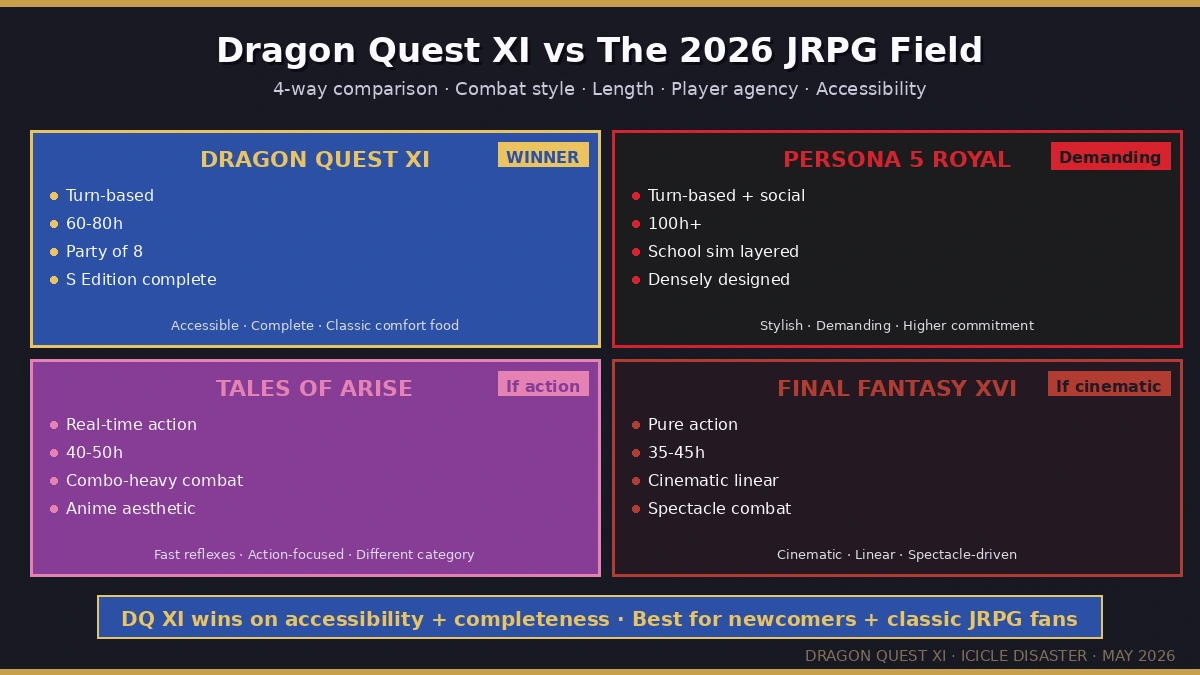
Here are three comparisons to help place where Dragon Quest XI belongs in the current field.
In terms of style and design mechanics, Persona 5 Royal is more refined but its emphasis on social simulation mechanics and its school year calendar require more active player management than Dragon Quest XI. If you are looking for the best looking and best designed JRPG and want to play on Persona 5 Royal's level, then there isn't much competition. If you are looking for something that is less demanding of your attention between dungeons, then Dragon Quest XI wins that competition.
Tales of Arise (see every Tales of Series game ranked for franchise context) is fundamentally different as it uses real time action based combat which rewards fast reflexes. If you are choosing between these games due to uncertainty regarding turn-based combat, then Tales of Arise is the better choice. If you prefer menu based combat strategy, then Dragon Quest XI is not a lesser option, but rather the better fit.
While Final Fantasy XVI is very good at what it does, it is more of a cinematic experience where the story is tightly authored and there is very little player choice that impacts the story mechanically. In comparison, Dragon Quest XI provides more player choice, more depth to your party, and more overall structure to the game.
When it comes to accessibility and completeness, Dragon Quest XI prevails. It is the JRPG that caters to the widest range of players, whether they are newcomers or returning fans from the genre, or veterans looking for a well-built classic as opposed to something highly experimental.
Who Should Play It (and Who Should Skip It)
Play Dragon Quest XI if: you enjoy classic turn-based JRPGs; you want a long game — 60-plus hours — that maintains a consistent quality rather than a game that's frontloaded with quality and hollow later; you are new to JRPGs (see best JRPGs for beginners for entry-point guidance) and want a game that teaches good habits while not punishing you and/or you want a story that builds to a really satisfying conclusion.
Skip Dragon Quest XI if: you want fast reactive combat and turn based combat feels like a waiting game to you; you need narrative complexity with morals that aren't black and white, divergent decisions, or political layers. This game is not concerned with any of that and is not pretending to be.
With current Steam prices — the S Edition goes on sale regularly — Dragon Quest XI S has a good value for the playtime it offers. Even at full price, more than sixty hours of JRPG content is a reasonable price in 2026.
For what to play next, the best RPGs of all time covers the full ranked list across platforms — including how Dragon Quest XI compares to the rest of the genre. If you are already convinced about the game and want a detailed explanation of mechanics and story, the complete Dragon Quest XI review is the next read. For broader 2026 review context, see our Final Fantasy 1987 review, Final Fantasy II review, Starbites review, and Crimson Desert review covering the editorial deep-dive format. Forward-looking coverage of upcoming JRPG releases appears in most anticipated JRPGs of 2027.